About this place
Bezděkov Castle is a modest but historically layered manor house in western Bohemia, standing in the municipality of Bezděkov in the Klatovy District of the Plzeň Region. Specifically, it sits in the part of the village called Koryta, right beside the Hořejší pond, whose water once fed the defensive moat around the site. Behind its current Gothic Revival facade lies a much older story — from a medieval fortified watchpost, through a Renaissance noble seat, to a 19th-century romantic rebuild.
How did the site begin?
The story starts in the 14th century, when a Gothic water fortress (tvrz) stood here — a fortified seat surrounded by water. Its first recorded owner was Elblin of Bezděkov, after whom the estate passed to King John of Luxembourg and later to the powerful Rožmberk family, specifically Petr of Rožmberk. That progression — from a local knight, to a king, to one of the most influential noble houses in the Kingdom of Bohemia — signals how strategically valuable this small stronghold once was in the region.
What happened during the turbulent medieval wars?
The fortress did not escape the region's conflicts. On the night of 19–20 May 1450 it was captured by force, and in 1468 it was besieged again. These events left the site weakened, and by the mid-16th century the tvrz had been reduced to purely agricultural use, gradually falling into disrepair — a common fate for smaller strongholds once their military relevance faded in favor of more modern fortifications.
How did the abandoned fortress become a Renaissance residence?
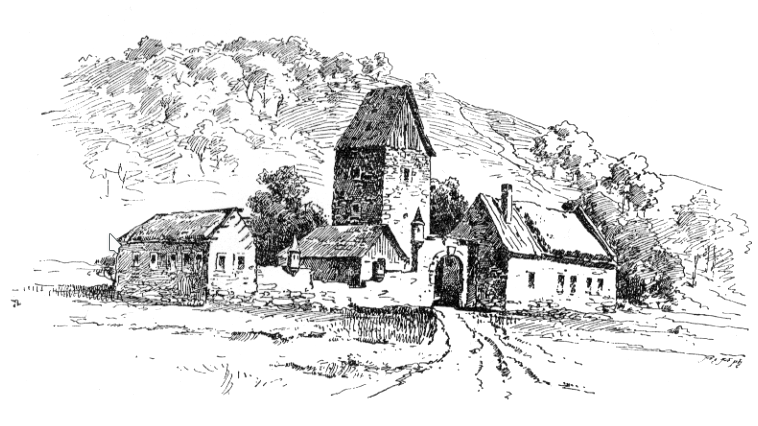
The turning point came in 1555, when Viktorin Pek of Římek bought the derelict property. He gradually restored and converted the old stronghold into a Renaissance noble residence. A defining feature of this phase was a large square tower surrounded by outbuildings, still protected by the original water moat — a direct link back to the site's defensive origins.
Where does the present Gothic Revival appearance come from?
The decisive transformation came in the 19th century. In the early 1800s the moat was drained and replaced with gardens. After 1820 the estate passed to František Korb of Weidenheim, on whose initiative a thorough mid-19th-century rebuild was carried out to designs by architect Vojtěch Ignác Ullmann. The work, completed after 1855, gave the building its current neo-Gothic and neo-Romanesque character — a style much favored at the time by Bohemian and Austrian aristocracy, drawing on English Gothic models.
What can visitors see today?
The present-day castle is a two-story, rectangular building with a distinctive square tower on its western front and polygonal turrets on the north wing. Its low roofs are hidden behind crenellations that echo medieval defensive architecture, though today they serve a purely decorative role. The ground floor still retains cross-vaulted ceilings, the oldest surviving interior feature. The whole complex is set within a park laid out in the 18th century, which remains an integral part of the historic grounds.
Can Bezděkov Castle be visited?
No. The building has been listed as a Czech cultural monument since 1958, but it remains in private hands and is closed to visitors. It can only be viewed from the outside, on a walk around Koryta and the shore of the Hořejší pond.
Frequently asked questions
Where exactly is Bezděkov Castle located? In the municipality of Bezděkov, in the village part called Koryta, Klatovy District, Plzeň Region, western Czech Republic.
Is the castle open to tourists? No, it is privately owned and its interiors are not open to the public.
What originally stood on the site? A 14th-century Gothic water fortress that was captured and besieged more than once during the medieval period.
Who gave the castle its current look? Architect Vojtěch Ignác Ullmann, who redesigned the residence in Gothic Revival style in the mid-19th century for owner František Korb of Weidenheim.
Nearby places

Earn badges for the places you visit
Download NextOnTrip, discover new places and check off your trails.