About this place
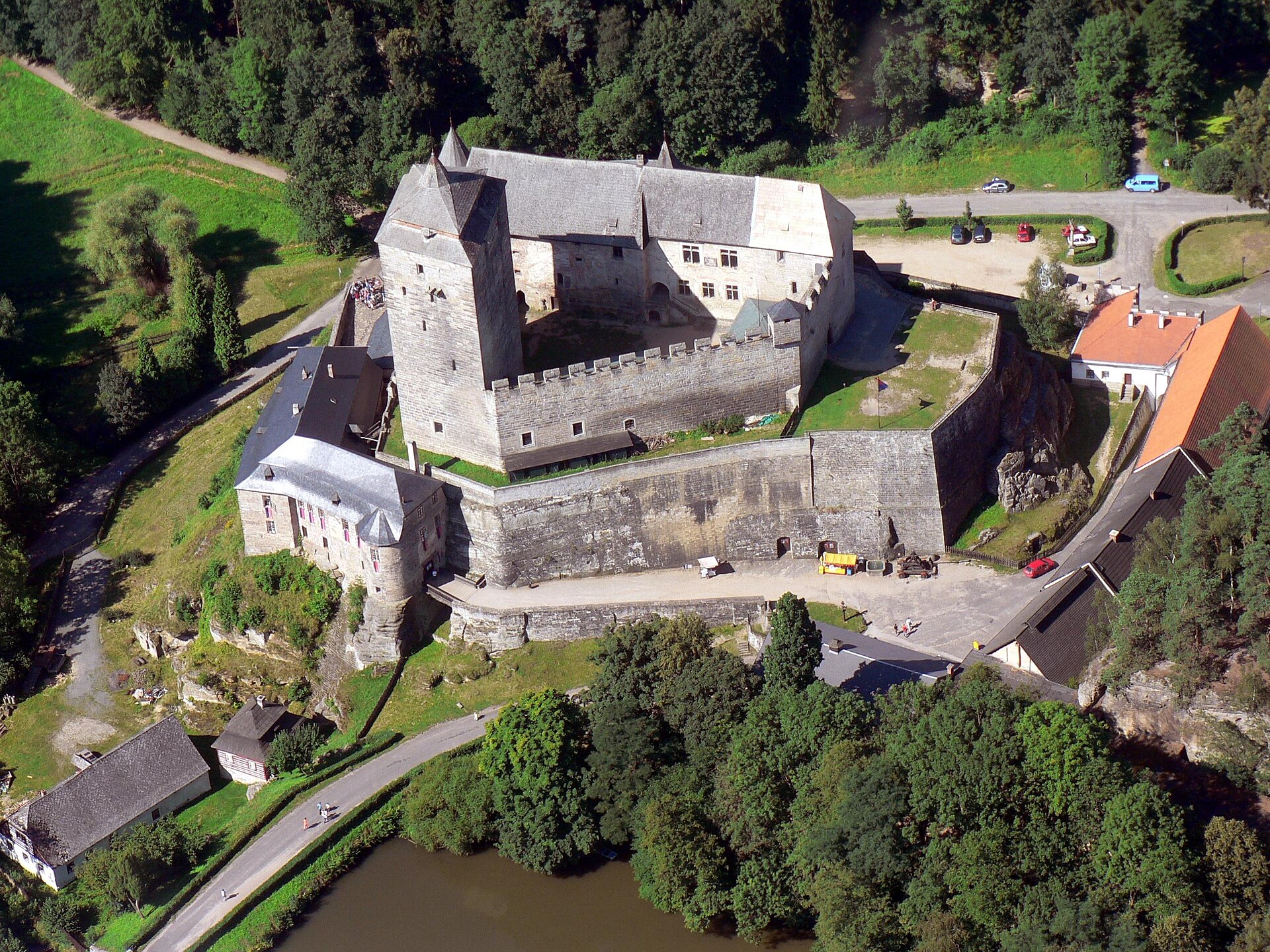
Kost Castle is a Gothic stronghold tucked into a wooded ravine in Bohemian Paradise, regarded as one of the best-preserved fortresses of its kind in northern Bohemia. It stands on a rocky spur near Podkost, part of the village of Libošovice in the Jičín district, Hradec Králové region — and unlike most Czech castles, which were later reshaped into Renaissance or Baroque residences, Kost has kept its original medieval outline for more than six centuries.
Where exactly is the castle located?
Kost rises above the valley of the Klenice River, in the heart of Bohemian Paradise (Český ráj), the first protected landscape area designated in the former Czechoslovakia. The rock massif carrying the castle is flanked on three sides by a deep gorge, a natural feature that made the site difficult to approach long before any walls went up.
Who built it, and when?
The castle is generally attributed to Beneš of Vartenberk, a member of a powerful noble family, who is believed to have founded it before 1349 — placing its origins in the middle of the 14th century. The Vartenberks held Kost for several generations, using it as one of their family seats. Around the turn of the 14th and 15th centuries, ownership passed to the Zajíc family of Hazmburk, who made it their principal residence and administered it until 1497.
How did it survive the region's turbulent history?
Kost was built as a compact "block-type" fortress — a dense, tightly organized structure rather than a castle ringed by extensive outer walls, but one that was correspondingly hard to break through. Combined with the natural shelter of the rocky spur, this design is credited with helping the castle withstand the Hussite Wars, a period in which many neighboring strongholds fell to the forces led by Jan Žižka. A popular local story holds that the fortress proved too tough even for Žižka to crack — a fitting association given that "kost" is the Czech word for "bone."
What makes its architecture distinctive?
At the core of the complex stands the White Tower, the castle's main keep, built on an unusual trapezoidal floor plan rarely seen in Czech fortress architecture of the period. Clustered around it are the residential palace wings, courtyards, and service buildings, including a former armory and a so-called "black kitchen." The whole complex has retained its Gothic character with remarkably little later alteration, making Kost a valuable reference point for anyone studying medieval defensive architecture in the region.
What can visitors see inside today?
The castle now operates as a museum and can only be visited on a guided tour, during the season running roughly from April to October. Four different tour routes are on offer: "Castle Palaces," which covers the living quarters, the former armory, the black kitchen, the Chapel of St. Anne and the courtyards (about 60 minutes); "Medieval Dungeon and Torture Chamber," focused on the castle cellars and the history of criminal justice (about 60 minutes); a combined route joining both of the above (about 110 minutes); and a shortened, barrier-free route (about 40 minutes). The halls house an extensive collection of edged and firearm weapons dating from the 17th to the 19th century, one of the highlights of the exhibition.
Frequently asked questions
Is Kost Castle open all year round? No — it operates seasonally, typically from April to October, with opening hours that vary by month (shortest in April and October, longest in July and August).
Can the castle be visited independently, without a guide? No, the interior can only be seen as part of a scheduled guided tour, in groups.
How long does a visit take? Anywhere from about 40 minutes for the shortened route up to 110 minutes for the combined route, depending on which tour is chosen.
Who owned the castle historically? It was founded and first held by the Vartenberk family, then passed to the Zajíc family of Hazmburk, who controlled it from around 1400 until 1497.
Why did the castle survive the Hussite Wars while others fell? Its compact, block-type construction and the natural protection of the rocky spur it stands on made it far harder to storm than many of the less fortified strongholds nearby.
Nearby places

Earn badges for the places you visit
Download NextOnTrip, discover new places and check off your trails.