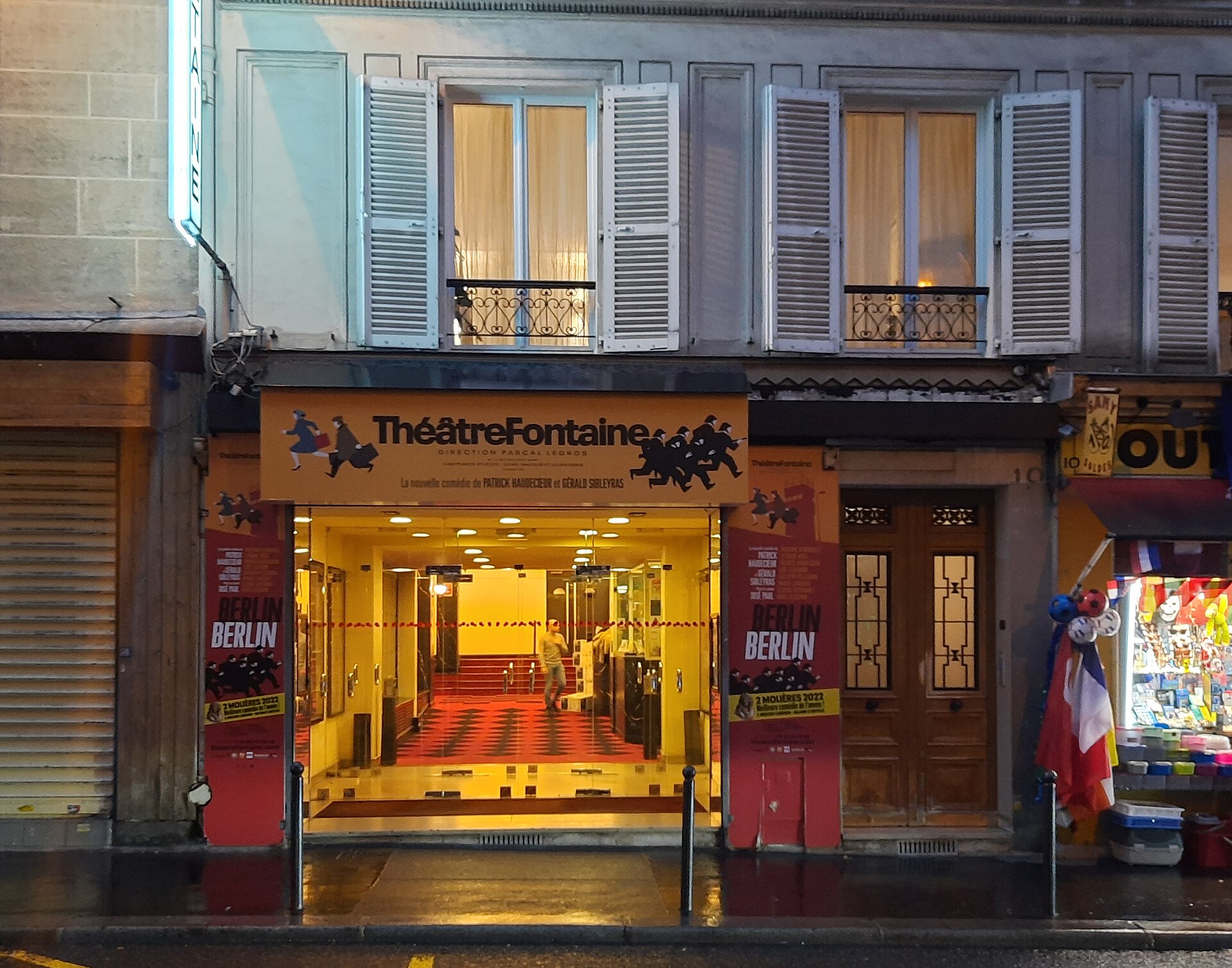
About this place
Théâtre Fontaine is an intimate playhouse in Paris, tucked away on rue Pierre-Fontaine in the 9th arrondissement, just steps from Pigalle. It's a venue where a colorful pre-war past meets a legendary postwar cabaret story, and where the auditorium still carries the look of the 1950s.
Where is it and how do you get there?
The theatre sits right in the heart of the 9th arrondissement, an area long associated with theatres and cabarets, only a short walk from Place Pigalle and the Moulin Rouge. The easiest way in is by metro to Blanche or Pigalle station, both just a few minutes' walk from the entrance. The neighborhood comes alive at night, so it's worth arriving a little early to settle in and take in the auditorium before the curtain goes up.
What's the story behind this building?
Before it became a theatre, the site had a surprisingly varied past — at one point it held a cemetery, and later a workshop manufacturing plumbing fittings. It wasn't until the 1930s that the address turned into an entertainment venue: Léon Volterra, the impresario who at the time also ran the Théâtre de Paris, Théâtre Marigny, the Lido, and the Casino de Paris, opened a cabaret here first known as El Garron, which quickly became famous under the name Boîte à Matelots.
The theatre's real story begins in 1951, when Jean Richard and André Puglia took over the site of a former cabaret called Le Chantilly, abandoned after the war following shady black-market dealings during the Occupation. The pair built a new 400-seat auditorium, inaugurated with a production starring Raymond Souplex, Louis de Funès, Roger Pierre, and Jean-Marc Thibault. The show was such a hit that the venue was soon expanded, raising capacity to 630 seats.
What will you see inside?
The interior still radiates 1950s style. Visitors are greeted at the entrance by a distinctive black-and-red checkerboard floor, while the auditorium is wrapped in rich red upholstery typical of classic Parisian playhouses. Overhead, a decorative ceiling shaped like a starry vault crowns the room — a detail that has been setting the mood for audiences for decades before the show even starts.
When is the best time to visit?
The theatre runs a year-round program that shifts with the seasons, ranging from boulevard comedies to one-person shows and musical productions. Since the auditorium holds a little over 600 seats, it's worth booking tickets for popular shows ahead of time, especially for weekend evenings, when Pigalle is buzzing and several nearby stages are running performances at once.
Frequently asked questions
How big is the Théâtre Fontaine auditorium? After its postwar expansion, the theatre seats 630 people — an intimate but not tiny house by the standards of Paris's boulevard theatres.
What stood on this site before the theatre? Before the venue existed, the plot was home first to a cemetery and later to a plumbing-fittings workshop; it only became an entertainment spot in the 1930s.
Who created the theatre in its current form? In 1951, Jean Richard and André Puglia took over the abandoned premises of the former Le Chantilly cabaret and turned them into the theatre's current auditorium.
How do you get to Théâtre Fontaine? The closest metro stations are Blanche and Pigalle, both just a few minutes' walk from the entrance through the heart of Paris's theatre and cabaret district.
Nearby places

Earn badges for the places you visit
Download NextOnTrip, discover new places and check off your trails.