About this place
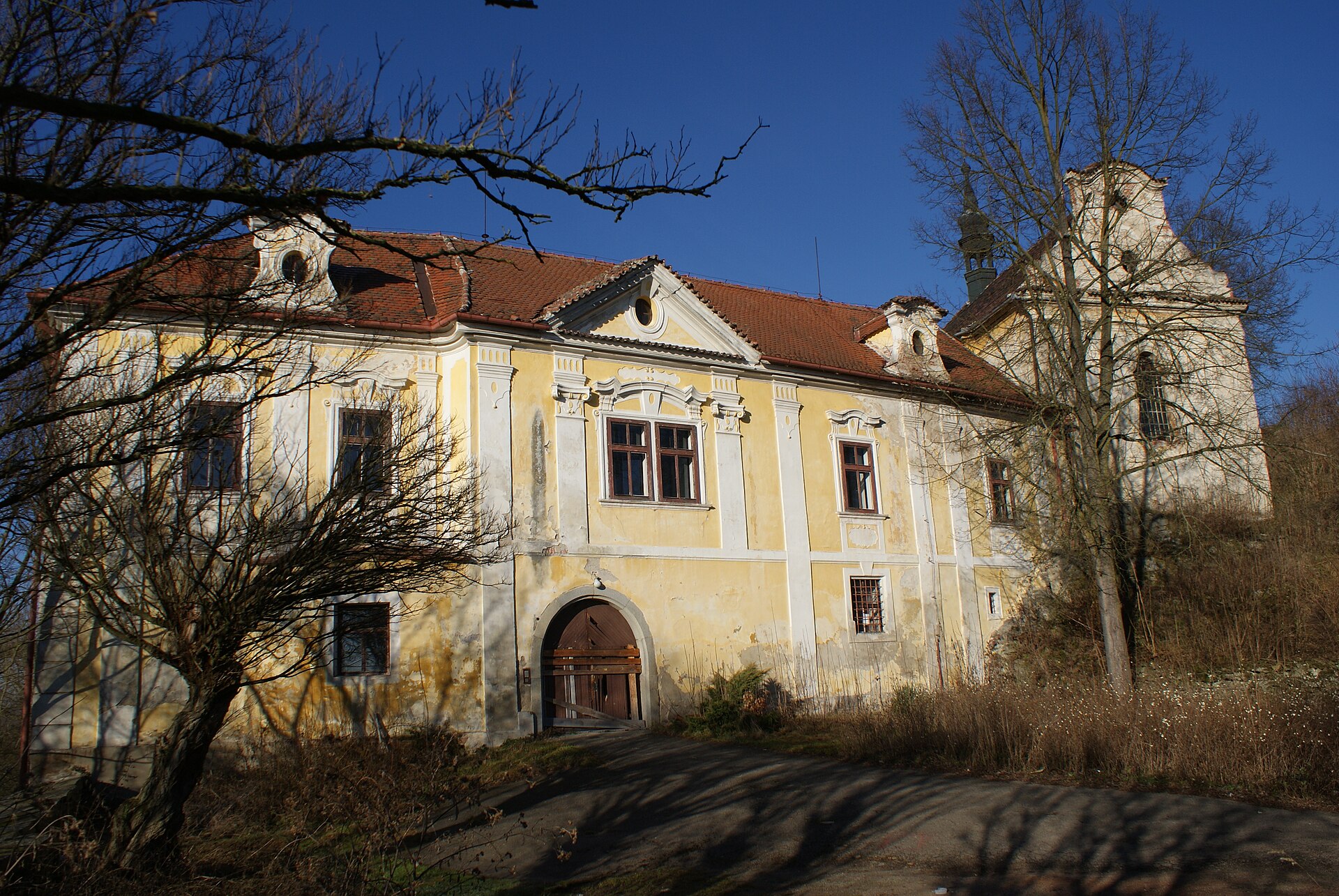
Štěkeň Castle is a Renaissance-and-Baroque residence in the village of Štěkeň in the Strakonice district of South Bohemia, Czech Republic. At first glance it looks like just another small provincial château, but its interior holds a rare concert hall, and the building's history is closely tied to Czech Baroque music and to a chapter of Catholic girls' education that continues to this day.
Where did this residence come from?
Štěkeň is first mentioned in written records in 1318. By the 14th century, a fortified stronghold (tvrz) already stood here, belonging to the Bavor family, a noble house that held sway over this part of southern Bohemia. Like most lesser-nobility seats of its time, the fortress combined defensive and administrative functions.
The turning point came in 1648, when the estate was acquired by the Losy of Losimthal family. Between 1664 and 1665, they rebuilt the old stronghold into an early Baroque château — essentially the structure visitors recognize today, though the façade was later reworked again, in 1784 and during the 19th century.
Why is the castle linked to music?
One member of the Losy of Losimthal family, Count Jan Antonín Losy of Losinthal, was born at Štěkeň. He became a lutenist and composer of European standing, one of the notable figures of Czech Baroque music. It was Losy who commissioned the château's grand concert hall — known as the Losy Hall or Great Hall — decorated with an illusionistic trompe-l'œil ceiling painting. That hall remains one of the building's most valuable interiors and the clearest trace of its musical past.
The Losy family died out in 1781. After protracted inheritance disputes, the estate passed to Count Josef Mikuláš Windisch-Grätz, a learned nobleman who took over as the new landowner.
How did the castle become a school?
An entirely new chapter opened in 1922, when the château was taken over by the Institute of the Blessed Virgin Mary (the English Ladies), a religious order dedicated to the education of girls. The sisters established a nursery, a novitiate, and a private girls' general secondary school with a boarding facility on the grounds. That educational and religious role has proven remarkably durable: the order's provincial superior still resides at Štěkeň today, making the château an unusual case of a noble residence that has continuously combined aristocratic heritage with an active institutional purpose.
Since 1958, the castle complex has been legally protected as a cultural monument, safeguarding both the building's structure and its historic interiors from uncontrolled alteration.
What is there to see?
Looking at the château from the outside, visitors can trace its successive building phases — from the early Baroque core of the 1660s, through the neoclassical façade adjustments of the late 18th century, to further changes made in the 19th century. The main interior draw remains the Losy Hall, with its painted ceiling, a feature that sets Štěkeň apart from other residences in the Strakonice region. Because the building still functions as a school and convent, visits usually need to be arranged in advance or coincide with open events, so it's worth checking access options locally before planning a trip.
Frequently asked questions
Can visitors tour Štěkeň Castle? Since the building still serves as a convent and school, public access is limited — it's best to check current visiting arrangements locally before arriving.
What is the castle's most valuable feature? The concert hall commissioned by Count Jan Antonín Losy of Losinthal, decorated with an illusionistic painted ceiling that commemorates the Losy family's musical legacy.
Who runs the castle today? Since 1922, the Institute of the Blessed Virgin Mary (the English Ladies) has managed the site as a girls' school; the order's provincial superior still resides at Štěkeň.
Since when has the castle been a protected monument? The Štěkeň castle complex has been listed as a protected cultural monument in the Czech Republic since 1958.
Nearby places

Earn badges for the places you visit
Download NextOnTrip, discover new places and check off your trails.