About this place
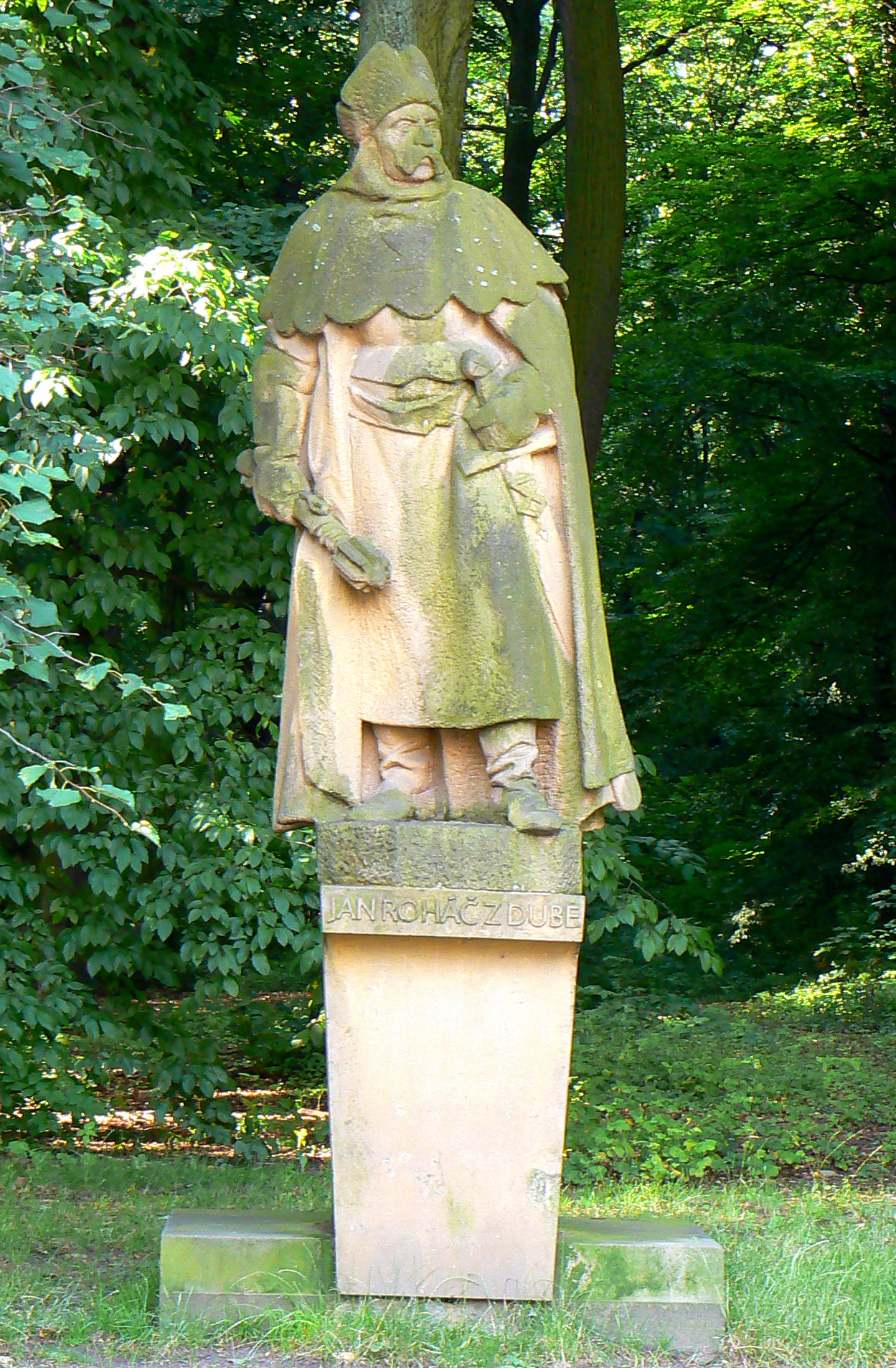
The Statue of Jan Roháč z Dubé by Alois Sopr stands in the Hvězda Game Reserve (Obora Hvězda) in Prague's Liboc district, right beside the main path leading from Libocká Street toward the Hvězda Summer Palace. Carved by Czech sculptor Alois Sopr, the stone figure shows a Hussite military commander fully armed for battle, a long sword at his hip and a halberd gripped in his right hand.
Who was Jan Roháč z Dubé?
Jan Roháč z Dubé was a Czech nobleman and military commander, one of the last significant leaders of the radical wing of the Hussite movement after the crushing defeat at the Battle of Lipany in 1434, which effectively ended the Hussite field army as an organized force. In the aftermath, Roháč and a small band of followers held out at Sion Castle near Kutná Hora, which became the final major stronghold of Hussite radical resistance in Bohemia. Following a prolonged siege, the castle fell in 1437, and Roháč was captured and taken to Prague, where he was executed along with a group of his companions.
When was the statue made, and where did it originally stand?
Alois Sopr designed and completed the statue between 1957 and 1960. It was first placed in front of the Old Town Hall in Prague, on the spot believed to be the site of Roháč's execution. It remained there for several years before the decision was made to relocate it.
Why was the statue moved to Hvězda Game Reserve?
In 1966 the statue was moved from the heart of historic Prague to the Hvězda Game Reserve in Liboc, where it still stands today along the main path leading in from Libocká Street, close to the reserve's northeastern entrance. Instead of the busy historic center, Roháč's figure now occupies a quiet, green corner of a former Renaissance hunting park, away from the crowds that fill the Old Town.
What does the statue look like?
Sopr depicted Roháč as a standing warrior in full battle dress, a long sword fastened at his waist and a halberd held firmly in his right hand. The pose and weaponry emphasize the stern, soldierly character of the figure, fitting for a man remembered as the commander of the last stronghold of Hussite resistance after Lipany.
What else is worth seeing nearby?
Hvězda Game Reserve is a historic hunting park founded in the 16th century, best known for the Hvězda Summer Palace, a small Renaissance building notable for its unusual star-shaped ground plan and one of the most distinctive structures of its kind in the Czech Republic. The reserve was also the site of the Battle of White Mountain in 1620, one of the decisive early engagements of the Thirty Years' War, whose outcome shaped Bohemian history for centuries afterward. A visit to the Roháč statue pairs naturally with a walk through the park and a look at the summer palace, rounding out a short trip into the region's history.
Frequently asked questions
Where exactly does the Jan Roháč z Dubé statue stand?
In the Hvězda Game Reserve in Prague's Liboc district, beside the main path leading in from Libocká Street, near the reserve's northeastern entrance.
Who created the statue?
Czech sculptor Alois Sopr, who made it between 1957 and 1960.
Where did the statue originally stand?
In front of the Old Town Hall in Prague, on the spot believed to be the site of Jan Roháč z Dubé's execution, until it was moved to Hvězda Game Reserve in 1966.
Who was Jan Roháč z Dubé?
A Hussite military commander and one of the last leaders of the radical Hussites, who defended Sion Castle after the Battle of Lipany and was executed in Prague in 1437 following the castle's fall.
What else can be seen in Hvězda Game Reserve?
The Renaissance Hvězda Summer Palace, notable for its star-shaped floor plan, and the site of the 1620 Battle of White Mountain.
Nearby places

Earn badges for the places you visit
Download NextOnTrip, discover new places and check off your trails.