About this place
Rybník Březina is a small but ecologically significant fishpond near the village of Dudín, in the western part of the Jihlava district, in the Vysočina Region of the Czech Republic. Its protected status has nothing to do with size or scenery in the conventional sense — it exists because the pond and its margins hold onto plant communities that have become increasingly scarce in a region dominated by intensive agriculture.
Where exactly is the pond located?
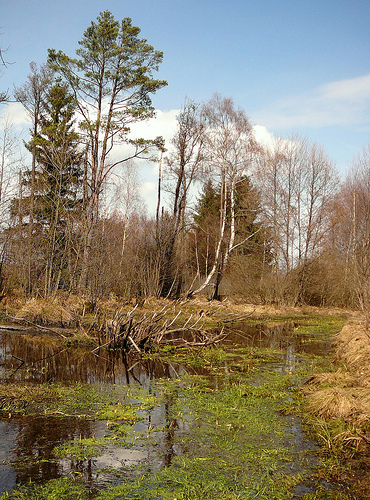
The reserve sits in a shallow valley depression right at the edge of a forest, at an elevation of roughly 586–594 meters above sea level. This combination — open water framed by trees on one side and a wet meadow on the other — creates a microclimate that suits species unable to tolerate either the full sun exposure of open commercial fishponds or the dense shade of forest pools.
Why was this pond given protected status?
Rybník Březina is a small, shallow, flow-through fishpond with mesotrophic water chemistry — meaning it carries a moderate, rather than high, nutrient load. That relatively low nutrient level is exactly what allows plants intolerant of nitrogen- and phosphorus-rich water to persist here, unlike in the heavily enriched carp ponds typical of the wider area. The water surface is dominated by yellow water-lily, while the shallower, boggy margins are covered by bog arum. Together, these two species define the pond's appearance for most of the growing season.
What rare plants grow here?
Beyond the two dominant species, the reserve protects a broader group of peatland and reedbed plants that are becoming rare regionally:
- round-leaved sundew — a carnivorous plant and reliable indicator of nutrient-poor peaty ground,
- two-flowered sedge — a wetland sedge species,
- bogbean — characteristic of transitional and low-nutrient peat bogs,
- early marsh-orchid — one of the few orchid species found on waterlogged meadows.
The presence of sundew is particularly telling: this predatory plant only survives where the soil is so nitrogen-poor that it must supplement its nutrition by trapping insects.
What surrounds the pond itself?
Right along the shoreline lies a rich littoral zone together with valuable peaty margins that gradually give way to a wet meadow. At the boundary between meadow and water grows an alder stand — black alder tolerates periodic flooding well and stabilizes the waterlogged ground with its root system, while also providing shade and shelter for birds and insects tied to the aquatic habitat.
Who manages the site?
The reserve falls under the oversight of the Vysočina Regional Authority, which monitors habitat conditions and enforces protection rules — including restrictions on intensive fish farming that could otherwise disturb the pond's delicate mesotrophic balance.
Frequently asked questions
Can you swim here? No. As a protected nature reserve, the site is managed for habitat conservation, not water recreation.
What is the best time to visit? Late spring to early summer, when yellow water-lily and early marsh-orchid are in bloom and sundew can be spotted along the peaty edges.
Is the site easy to reach? Rybník Březina lies right next to the village of Dudín, making it a fairly accessible stop for short excursions around Jihlava, though visitors should keep to marked boundaries out of respect for the protection regime.
How does this pond differ from typical commercial fishponds in the area? The key difference is water trophic status — the mesotrophic character of Březina lets sensitive species survive where they would otherwise be outcompeted by algae and fast-growing vegetation in the nutrient-rich, eutrophic carp ponds common elsewhere in the region.
Nearby places

Earn badges for the places you visit
Download NextOnTrip, discover new places and check off your trails.