Save this place and discover nearby attractions with NextOnTrip
In the app you can add it to your favorites, see what else is worth visiting nearby on the map, and earn a badge for your visit.
The app is available for iPhone and Android.
About this place
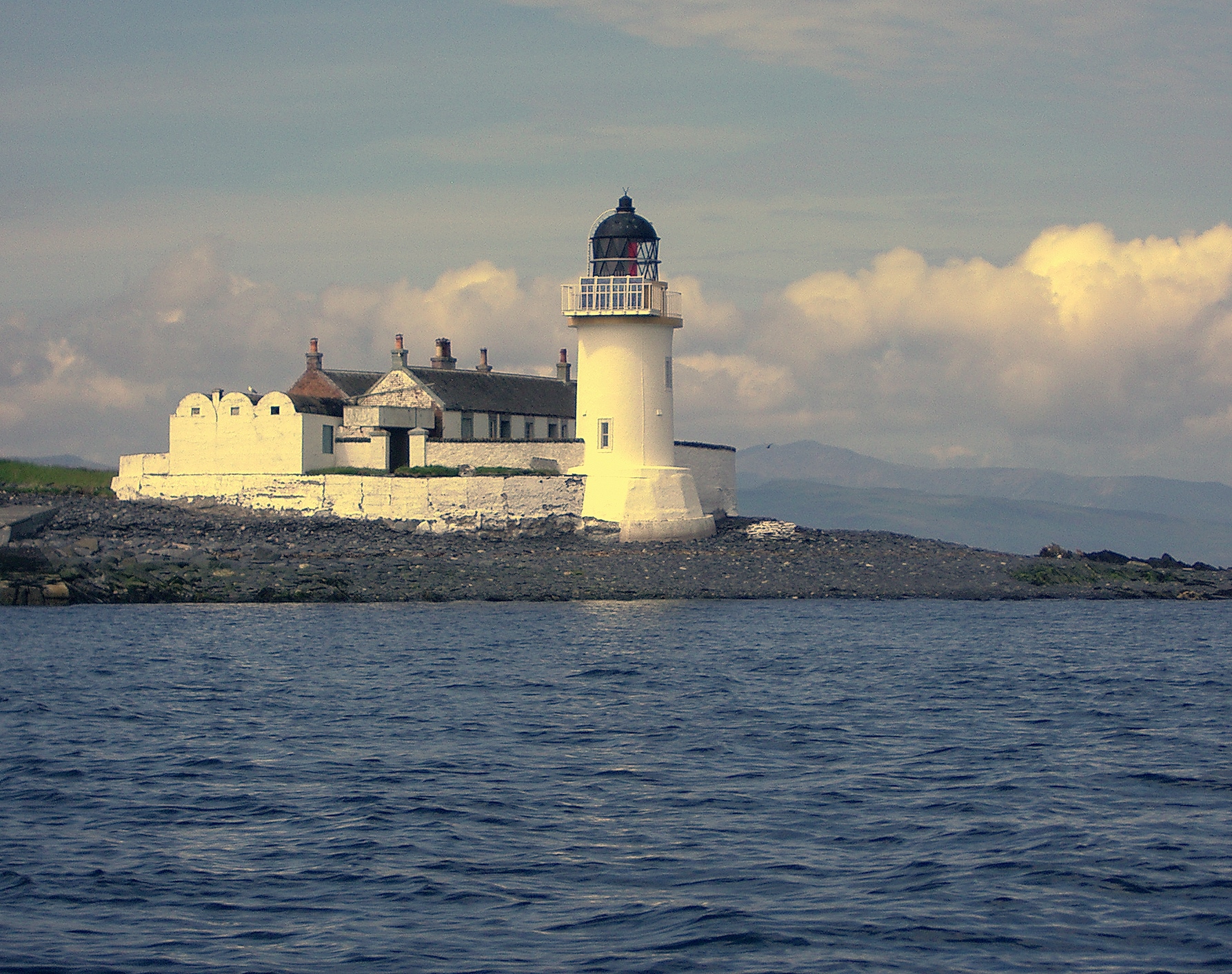
Ruadh Sgeir Lighthouse is a small automatic light on a rocky islet in the Sound of Jura, off the coast of Argyll and Bute in western Scotland. It sits out at sea between the northern tip of the island of Jura and the mainland shore, close to the approach to Loch Crinan. It suits sailors, landscape photographers and anyone curious about maritime engineering, rather than visitors looking for a staffed attraction.
Where is Ruadh Sgeir?
The islet lies in the northern part of the Sound of Jura, at roughly 56.07 N, 5.66 W. To the west you see the hills of Jura, and to the east the Argyll coast. The light stands near Loch Crinan, the western entrance of the Crinan Canal, which gives boats a shortcut between the Atlantic and the Firth of Clyde. Do not confuse it with Skervuile Lighthouse, which stands on a different rock in the same waters. The Canmore record keeps the two clearly apart.
What is its history?
A first light appeared on the islet in 1906. It was designed by David A. and Charles Stevenson, members of the well-known lighthouse-engineering family, and the Northern Lighthouse Board announced the unmanned station to mariners in November 1906. The original light ran on acetylene gas.
The present tower dates from 1983 and replaced the older structure. It is built of glass-reinforced plastic (GRP), and Historic Environment Scotland notes that it was among the first towers of this type. In 2002 the power supply switched to solar. The light now runs automatically with no resident crew.
In December 2020 the lighthouse was added to Scotland's listed buildings as a Category C structure (reference LB52575). The listing rests mainly on the tower's place in the story of GRP lighthouse construction.
What kind of light does it show?
The lamp is a white LED that flashes once every six seconds and can be seen for eight nautical miles. For yachts and boats crossing the Sound of Jura, and for vessels using the Crinan Canal shortcut, it is a useful navigation mark, especially after dark.
How can you see it?
Ruadh Sgeir is a sea-washed rock, so there is no walking route and no access inside. The practical options are:
- a yacht or small-boat trip through the Sound of Jura, including from the Crinan area,
- boat tours on the Argyll coast that pass through the strait,
- a look from the shore with binoculars or a telephoto lens when visibility is good.
Late spring and summer are the best seasons, with long days and calmer seas. Weather on Scotland's west coast changes fast, so check the forecast and the tidal streams in the strait before you set out.
What else is nearby?
Argyll offers the Crinan Canal and its locks, the island of Jura with its distillery and the Paps of Jura, and many sea lochs and peninsulas for walking. The lighthouse fits easily into a day on the water along this stretch of coast.
Frequently asked questions
Can I go inside Ruadh Sgeir Lighthouse? No. It is an unmanned light on a rock surrounded by sea. You can view it from the water or from a distance.
Who built it? David A. and Charles Stevenson designed the first light in 1906. The current plastic tower went up in 1983.
Is it a listed building? Yes. Historic Environment Scotland listed it in December 2020 in Category C.
How does its light work? A white LED flashes every six seconds and is visible for eight nautical miles. It runs on solar power.
Nearby places


Earn badges for the places you visit
Download NextOnTrip, discover new places and check off your trails.