About this place
Pont-canal sur la Baïse is a stone canal bridge in Feugarolles that carries the Canal latéral à la Garonne over the Baïse river, right on the boundary with the neighboring commune of Vianne, in the Lot-et-Garonne department.
What exactly is this structure?
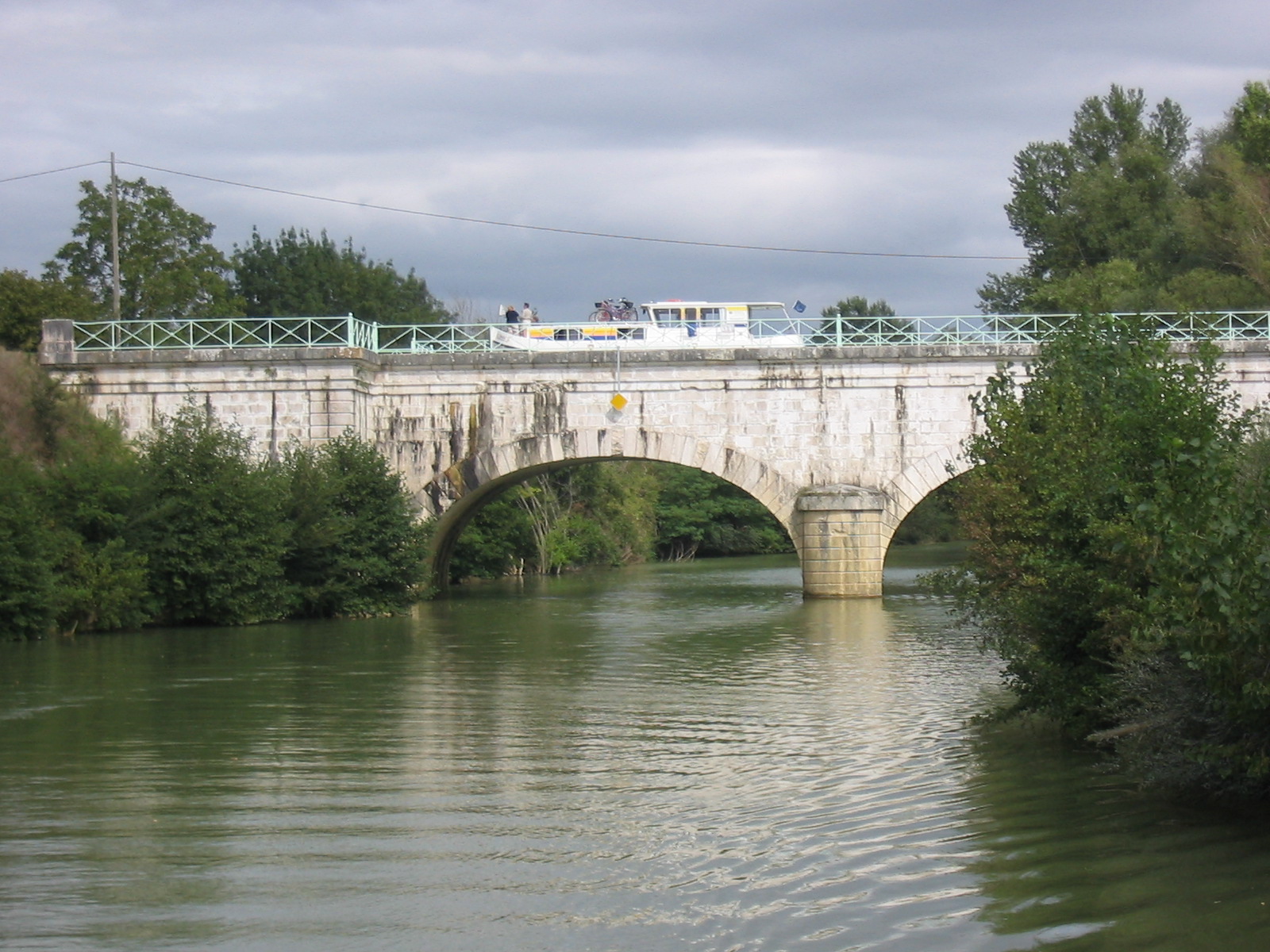
A canal bridge, or aqueduct, does something counterintuitive: it carries a water-filled channel — with barges floating on it — above a natural river, rather than the river flowing under a road or railway bridge in the usual sense. Here, the Baïse flows below while boats navigate above, inside the canal's own stone trough. The structure is built from cut stone quarried in the Quercy region and rests on three semicircular arches (plein cintre), a classic round-arch form typical of 19th-century French civil engineering. It is the second canal bridge built along the Canal latéral à la Garonne counting from the Canal du Midi side — together the two canals form the Canal des Deux Mers, the historic waterway linking the Atlantic to the Mediterranean.
The aqueduct was built between 1839 and 1853 under the direction of Ponts et Chaussées engineers Jean-Baptiste de Baudre and Jean-Gratien de Job, who oversaw several key sections of the canal. Because the channel is narrow, boats can only cross in one direction at a time, taking turns from either side. In recognition of its engineering and historical value, the structure was listed as a monument historique by decree on 21 August 2003.
How do you get there?
The canal bridge sits along the Canal de Garonne, on the stretch linking Buzet-sur-Baïse with Feugarolles and Vianne, in the heart of Lot-et-Garonne — a region also known for the Buzet AOC vineyards. The easiest way in is by car, parking near one of these villages and continuing on foot or by bike along the towpath (chemin de halage), which runs on both banks of the canal and is open to walkers and cyclists. The site is also a regular stop for canal traffic: tourist barges and rental houseboats (péniches) cruising the Canal de Garonne pass through this section routinely.
What will you see on site?
The best view of the aqueduct itself is from the bank of the Baïse, looking up at the three stone arches carrying the canal above. It's worth walking the towpath on both sides of the crossing to see the structure from different angles — from below, where the full height of the piers is visible, and from the canal level itself, where you can watch barges glide across. The setting is quietly rural: tree-lined banks, still water, and the unmistakable atmosphere of 19th-century canal engineering that is still doing exactly the job it was built for.
When is the best time to visit?
Spring and summer bring the most canal traffic, so those seasons offer the best chance of watching a barge actually cross the bridge. The towpath walk is also pleasant in autumn, once the heat has faded and the trees along the canal turn color. In winter, water levels can run lower and boat traffic is minimal, though the structure itself remains visible and accessible year-round.
Frequently Asked Questions
What's the difference between a canal bridge and an ordinary bridge? A canal bridge (pont-canal) carries a water-filled channel with barges on top of it — the canal crosses over the river, rather than a road or railway crossing over it. Here, the Canal de Garonne crosses the Baïse river in exactly this way.
How many arches does it have, and what is it built from? The aqueduct has three semicircular arches, built from cut stone brought in from the Quercy region.
Can you cross it with your own boat? Yes, it's an active navigable section of the Canal de Garonne, but because the channel is narrow, crossings are one-way — boats must give way to any vessel already crossing from the opposite side.
When was it listed as a historic monument? The canal bridge was classified as a monument historique by decree on 21 August 2003, in recognition of its engineering and historical significance.
Nearby places

Earn badges for the places you visit
Download NextOnTrip, discover new places and check off your trails.