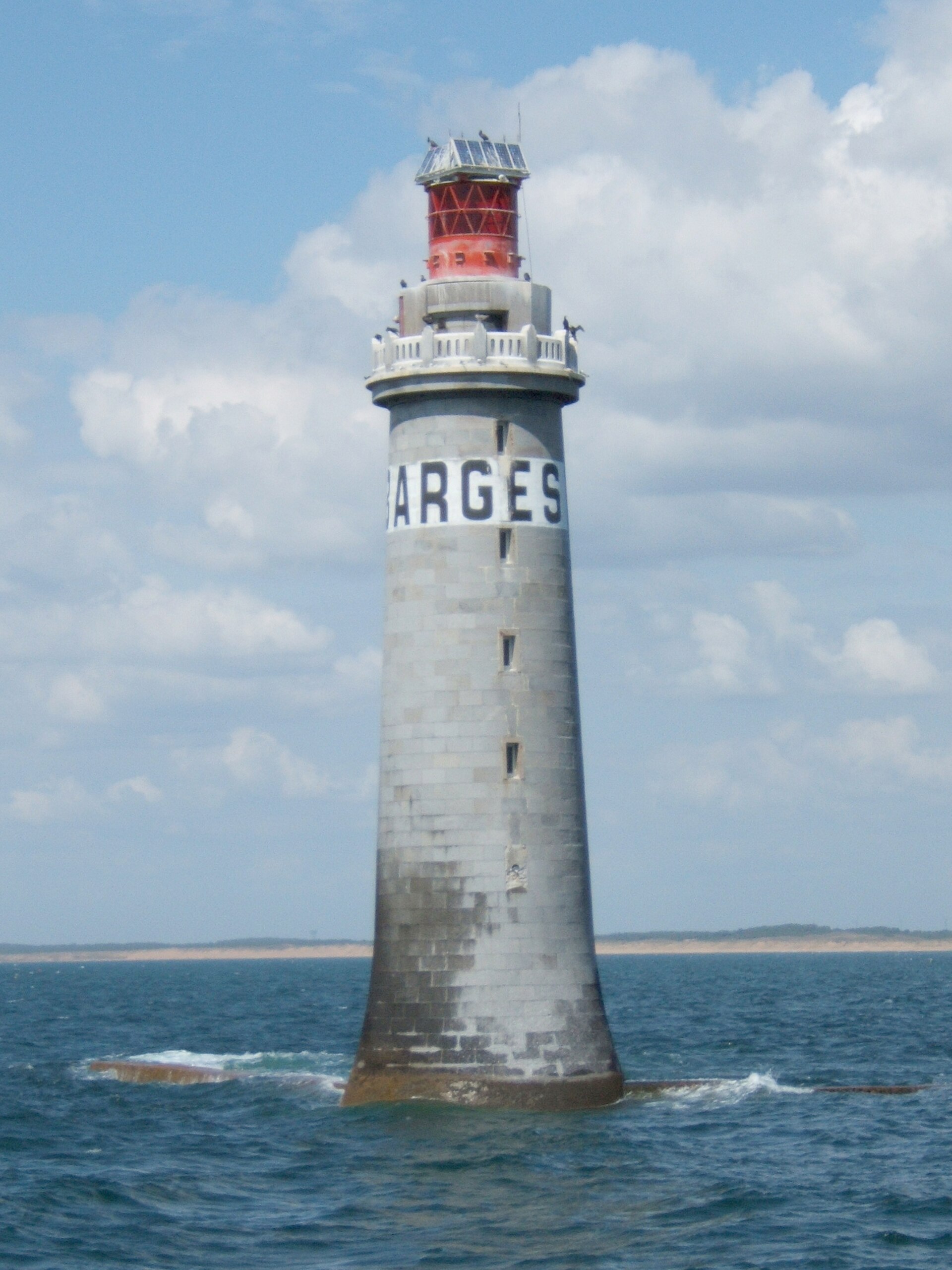
About this place
Phare des Barges is a lighthouse standing on the rocky Grandes Barges reef, roughly 2 km off La Chaume, part of the town of Les Sables-d'Olonne in the Vendée region on France's Atlantic coast. It rises alone out of the sea at a spot that has long posed a hazard to ships approaching the port of Les Sables-d'Olonne.
Where exactly is the lighthouse located?
The Barges are a cluster of dangerous rocks breaking the surface right at the approach to the port of Les Sables-d'Olonne. The lighthouse was built directly on this reef plateau to warn ships away from the submerged obstacles below. It can be seen from the town's beaches and quays, and the closest views come from the tourist boat trips that leave the harbour and head out past the mouth of the Auzance river.
When was it built, and how long did construction take?
Work on the lighthouse began in 1857 and finished in 1861 — a four-year build that was no small engineering feat, given that the site was only reachable when sea conditions allowed. The lighthouse was formally lit and put into service on 14 October 1861, becoming one of the key navigation markers along this stretch of the Vendée coast.
What is the tower made of, and how tall is it?
The structure was built from blue granite quarried at Avrillé, a town further inland in the Vendée. The tower stands 24.81 metres tall with a base 12 metres in diameter — a solid, squat shape designed to withstand the full force of wind and waves in such an exposed, open-sea position.
What makes this lighthouse historically significant?
Phare des Barges holds two notable firsts in the history of French maritime lighting. In 1963, at the initiative of broadcaster Jean Nohain and the magazine "Télé 7 Jours," it became the first lighthouse in France fitted with a television set, a gesture meant to highlight the modernisation of the lighthouse service. Then, in 1971, it became the first fully automated lighthouse in the country, marking the end of on-site keepers and the start of remote-controlled navigation lighting.
Can visitors go inside?
The lighthouse is not open to the public — its position on an exposed reef, surrounded by water and accessible only under specific sea conditions, effectively rules out regular interior visits. It can, however, be admired from the outside, ideally on a boat trip along the Les Sables-d'Olonne coastline, or from land at the beaches, the harbour promenade, or vantage points around La Chaume. Since 21 October 2011, the lighthouse has been listed as a historic monument (monument historique), recognising its value to the region's maritime heritage.
Why is it worth noticing on a visit to the Vendée?
For visitors to Les Sables-d'Olonne, best known as the starting point of the Vendée Globe round-the-world race, Phare des Barges is a tangible symbol of the town's maritime history. It also makes a striking photography subject — its solitary silhouette against the sea, especially at sunset or during stormy weather, is one of the most recognisable sights along this part of the Atlantic coast.
Frequently asked questions
Can Phare des Barges be seen from the beach? Yes, the lighthouse is visible from the beaches and quays of Les Sables-d'Olonne and from the La Chaume district, though it stands about 2 km offshore on open water.
Who designed and built the lighthouse? Available sources do not name a specific architect — what is documented is that construction ran from 1857 to 1861 and that the structure was built from granite quarried at Avrillé.
Is the lighthouse still operating, and is it automated? Yes, it remains an active navigation aid; since 1971 it has operated fully automatically, with no keeper required on site.
Is it possible to go inside the lighthouse? No, the interior is not open to visitors because of its isolated offshore location — it can only be viewed from the outside, either from land or from the water.
Nearby places

Earn badges for the places you visit
Download NextOnTrip, discover new places and check off your trails.