About this place
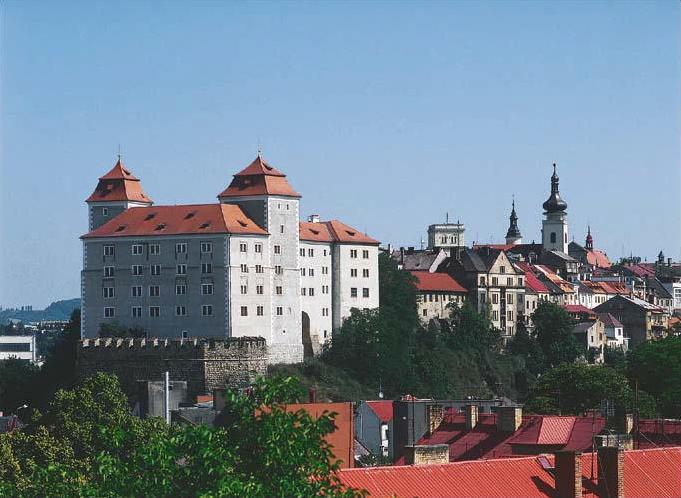
Mnichovo Hradiště Chateau is a Baroque residence standing in the town of the same name, in the Bohemian Paradise area of central Bohemia, on the bank of the Jizera River. The estate is regarded as one of the best-preserved chateau complexes in the Czech Republic, and its story is tightly bound to the Waldstein family, who owned the property from the first half of the 17th century until 1945.
How did the estate begin?
A Renaissance castle originally stood on the site, built by Václav Budovec z Budova, a Czech nobleman and political writer. After the Bohemian estates lost the Battle of White Mountain, the property was confiscated, and in 1623 it was bought by Albrecht Wenzel Eusebius von Wallenstein — the future imperial generalissimo and Duke of Friedland, one of the most famous and controversial figures of the Thirty Years' War. Wallenstein never settled here permanently: already in 1627 he sold the estate to his cousin Maxmilian von Wallenstein, after which it remained in the family's hands for the next three centuries.
When did the chateau take on its current Baroque look?
The transformation from the older Renaissance castle into a Baroque chateau took place in the second half of the 17th century. The rebuilding is associated with architects and master builders active in Bohemia at the time, including M. A. Canevalle and M. Ramondi. This is when the layout and overall character of the building that survives today — with later additions — took shape, and it is this Baroque substance that gives the complex its heritage value.
What is the chateau's connection to Albrecht von Wallenstein?
Although Wallenstein himself spent little time at Mnichovo Hradiště, the branch of the family that settled here for generations cultivated the memory of their most famous ancestor. Since 1785, his remains have rested in the Chapel of St. Anne on the chateau grounds, concealed behind a marble plaque bearing a bronze bust. After the Duchcov branch of the family died out, part of its collection was transferred to Mnichovo Hradiště in 1901, including a library of roughly 22,000 volumes — a collection once managed by Giacomo Casanova, who spent his final years attached to the Duchcov court.
What can visitors see inside the chateau today?
Following the nationalization of the estate in 1945, the building was designated for museum use as a cultural hub for a region rich in historic monuments, and a municipal museum opened there in 1946. Visitors today can tour a route through the state rooms, collections connected to the Waldstein family, and the library mentioned above. The chateau is also surrounded by a park, which rounds off a visit and offers a quiet place to rest along the Jizera.
Why is Mnichovo Hradiště worth a visit?
The site brings together three layers rarely found in one place: high-quality Baroque architecture, a genuine link to one of the most compelling figures in Central European history, and an unusual episode tied to Casanova and the Duchcov library. For travelers exploring Bohemian Paradise, the chateau is a natural stop — it sits close to other regional attractions, and the town itself has kept a calm, provincial character.
Frequently asked questions
Can the chateau interiors be visited with a guide? The interiors are shown as part of organized tours led by museum staff, who cover the history of the Waldstein family and the exhibited collections.
What is the chateau's main highlight? The strongest draw is the connection to Albrecht von Wallenstein, including his remains kept in the chateau chapel, together with the unique library transferred from Duchcov Castle.
Is there a park around the chateau? Yes, the chateau is surrounded by a park that can be explored separately from the interior tour, close to the Jizera River.
How is the chateau linked to Giacomo Casanova? Casanova managed the library at Duchcov Castle, which belonged to the same Waldstein line, during his final years; once that branch of the family died out, the book collection was moved to Mnichovo Hradiště.
Is the chateau a protected monument? Yes, the property is listed as a national monument of the Czech Republic, consistent with catalog records for the site.
Nearby places

Earn badges for the places you visit
Download NextOnTrip, discover new places and check off your trails.