About this place
Osiky Castle is a forgotten ruined stronghold in the cadastral territory of Synalov, in the Brno-venkov district, within the Tišnov region of Moravia. All that remains today of this once-fortified site are earthworks hidden in the forest, yet the place still draws history enthusiasts and hikers tracing the medieval past of the region.
How old is Osiky Castle?
Historians place the founding of the stronghold in the 13th century, although no documents from that era have survived. The earliest written record connecting this site to an existing fortification only dates from 1390 — meaning more than a century separates the castle's likely founding from its first mention in historical sources, which explains why so little is known about its early history.
Why doesn't anyone know the castle's original name?
This is one of the site's biggest puzzles: the original name of the stronghold appears in no surviving historical document. Older literature associated the ruins with a castle called Levnov, but in 1971 historian Vladimír Voldán convincingly demonstrated that Levnov actually referred to a different fortification, located near Ketkovice. Fifteen years later, in 1986, Miroslav Plaček proposed an alternative theory, linking these ruins to a poorly documented site known as Zuzínov, where a certain Kuna of Zbraslav and Kunštát reportedly served as castellan in 1250. Neither theory has been conclusively proven, so in practice the ruins are simply known by the conventional name Osiky, borrowed from the nearby village.
What can visitors actually see on site today?
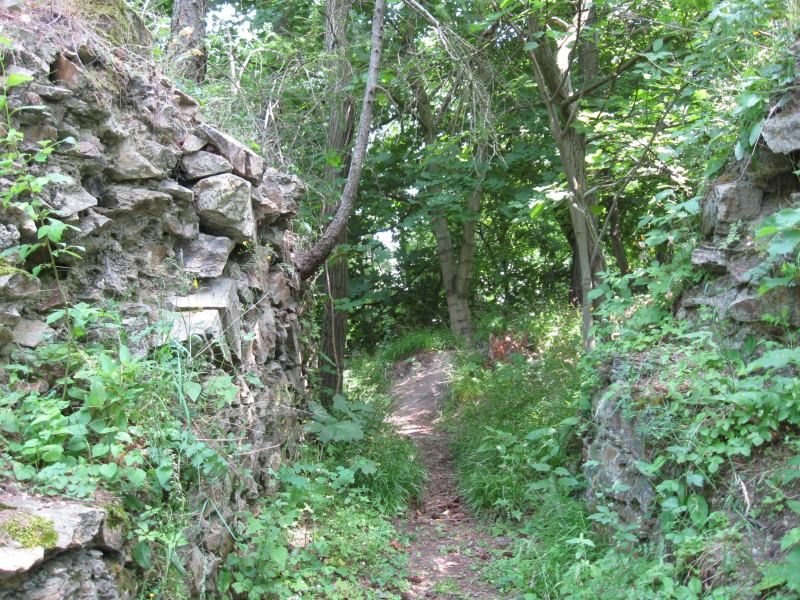
The castle was built on a spur cut off from a larger plateau by a semicircular ditch that merged into a surrounding rampart. The outer ditch reached up to eight meters in width and six meters in depth, except on the western side, where a steep natural slope took over the defensive role. Inside this outer line stood a second, inner rampart and ditch, and the space between the two defensive rings once held residential and farm buildings, most likely built of wood. The castle's core, protected by the innermost ring of fortifications, was built in stone. Today only the earthworks survive — ditches and ramparts, partly overgrown by forest — with no walls or visible foundations remaining above ground.
How do you get to the ruins, and is entry free?
The ruins are freely accessible year-round at no cost. The most straightforward approach follows the road from the village of Osiky toward Lomnice: before crossing the bridge over the stream, turn toward the Church of St. Stanislaus, then follow the forest path uphill to the hillfort itself. Sturdy footwear is recommended, since the terrain is uneven and the paths are unpaved. There is no visitor infrastructure on site — no information boards, viewpoints, or marked trails beyond the basic approach path.
Is Osiky Castle a protected site?
Yes. The former castle grounds are listed as a protected cultural monument of the Czech Republic, classified as an archaeological site. This means any excavation or ground disturbance within the ruins is prohibited without authorization from the relevant heritage authorities.
Frequently Asked Questions
Are there any standing walls left at Osiky? No. Only earthen features remain — ditches and defensive ramparts. Neither the stone core nor the timber outbuildings survived to the present day.
What was the castle originally called? It's unknown. Historians have proposed the names Levnov and Zuzínov, but neither theory has been confirmed, so the site is conventionally referred to as Osiky after the nearby village.
Is there an entry fee for the ruins? No, the site is freely accessible year-round, with no fee and no fixed opening hours.
How long does the walk from Osiky village take? The route follows a short stretch of road and then a forest path uphill near the Church of St. Stanislaus; the walk typically takes fifteen to twenty-five minutes depending on pace.
Nearby places

Earn badges for the places you visit
Download NextOnTrip, discover new places and check off your trails.