Save this place and discover nearby attractions with NextOnTrip
In the app you can add it to your favorites, see what else is worth visiting nearby on the map, and earn a badge for your visit.
The app is available for iPhone and Android.
About this place
The Auschwitz-Birkenau camp in Oświęcim is a former German concentration and extermination camp, today a memorial and museum. It stands in Oświęcim, in Lesser Poland, about 60 km west of Kraków. People come here not as tourists in the usual sense, but to learn the history of the Holocaust and pay tribute to its victims.
What was Auschwitz?
The Germans founded the camp in 1940, after occupying Poland. It was originally meant to hold Poles who were being arrested in such numbers that existing prisons ran out of space. Over time it grew into a complex of several camps. Auschwitz I was the original main camp, Auschwitz II-Birkenau became the centre of mass extermination, and Auschwitz III-Monowitz was a forced-labour camp tied to industry.
Auschwitz was the largest concentration camp of the Third Reich and the only one where systematic killing in gas chambers operated alongside slave labour. More than 1.3 million people were deported there, and about 1.1 million died. The great majority of the victims were Jews from across occupied Europe. Poles, Roma and Sinti, Soviet prisoners of war and prisoners of other nationalities were also murdered here. The Red Army liberated the camp on 27 January 1945, a date now observed as International Holocaust Remembrance Day.
What can you see?
A visit covers two separate areas, a few kilometres apart.
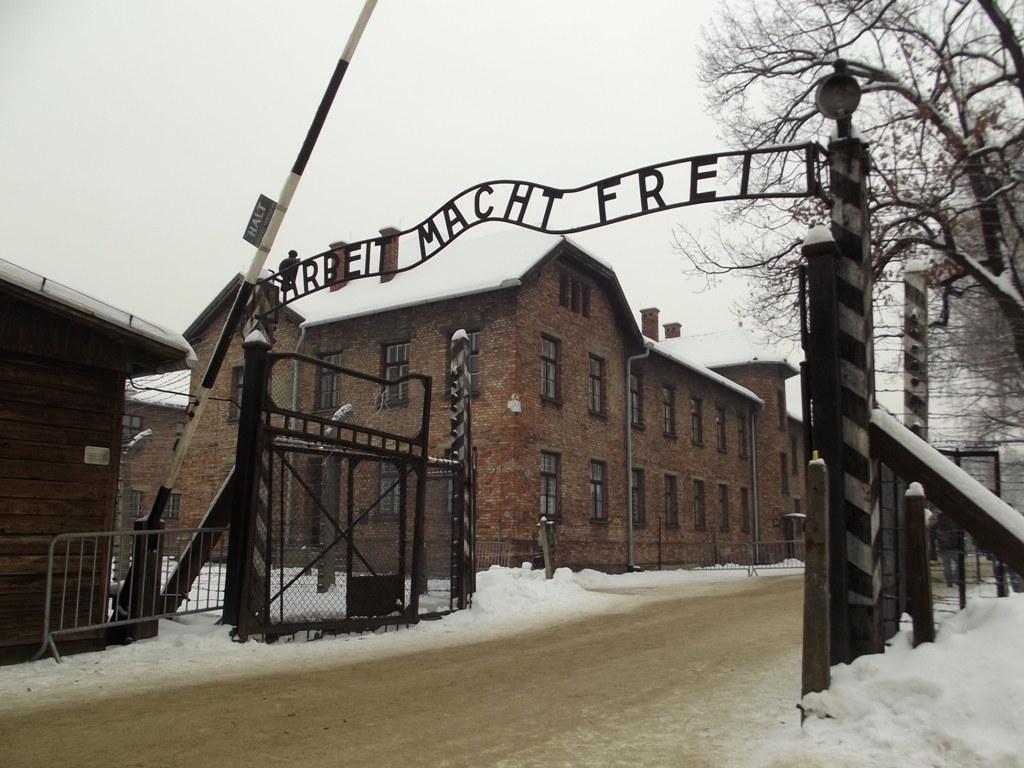
- Auschwitz I – the former brick barracks, the gate bearing the words "Arbeit macht frei", blocks housing national exhibitions, and preserved buildings and rooms linked to the killing. The displays include personal belongings of victims, documents and photographs.
- Auschwitz II-Birkenau – a vast site with the railway ramp, remains of wooden barracks, standing chimneys, and the ruins of gas chambers and crematoria that the Germans partly destroyed before fleeing. Its scale shows how mass extermination was planned and carried out.
Museum and World Heritage status
The Auschwitz-Birkenau State Museum was established in 1947 to preserve the surviving remains and provide education. In 1979, on Poland's initiative, the site was inscribed on the UNESCO World Heritage List as "Auschwitz Birkenau. German Nazi Concentration and Extermination Camp (1940-1945)". It was meant to stand also for other similar sites.
Visiting practicalities
- Do you need a ticket? Entry to the grounds is free for most of the year, but you need a named admission card, best booked in advance on the museum's official website. Slots can run short in the high season.
- How long does it take? Seeing both parts usually takes several hours. A guided tour or the museum's suggested route is the easiest way to do it.
- How to get there? From Kraków, you can reach Oświęcim by car, train or bus. A museum shuttle bus runs between Auschwitz I and Birkenau.
- Who is it for? The exhibition is deeply upsetting. The museum advises against visiting with children under 14.
Frequently asked questions
Is Auschwitz a single site? No. The museum covers Auschwitz I and Auschwitz II-Birkenau. The remains of Monowitz lie outside the visitor route.
How many people died at Auschwitz? Of more than 1.3 million deportees, about 1.1 million lost their lives.
When was the camp liberated? On 27 January 1945, by Soviet troops.
Can I take photos? The museum allows photography in designated areas, but respect and quiet are expected. Check the current rules before you go.
Nearby places


Earn badges for the places you visit
Download NextOnTrip, discover new places and check off your trails.