About this place
Nécropole des Près-de-l'Eau is a prehistoric burial mound complex in Lacrost, in the Saône-et-Loire department of eastern France.
Where is it located?
The site spreads across roughly 15 hectares of land known as Près-de-l'Eau, about 700 metres from the left bank of the Saône river. It sits in a quiet, rural corner of Burgundy, surrounded by farmland rather than modern development.
What will you see there?
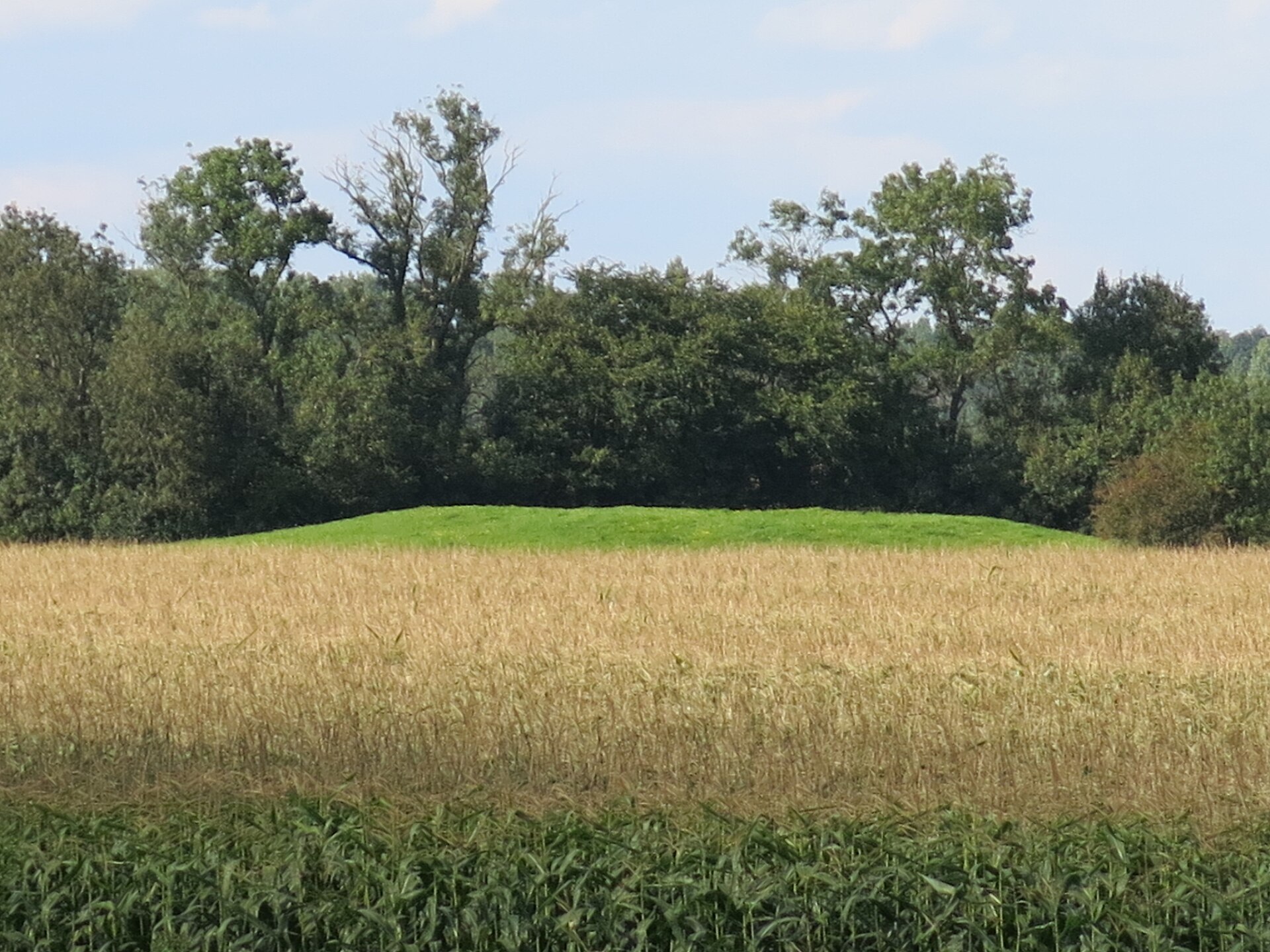
Nearly forty burial mounds (tumuli) are spread across the necropolis, arranged in three lines running roughly north to south, parallel to the river. More mounds cluster in the southern part of the site, while the largest ones sit further north - their diameters range from 5 to 45 metres, and their height from just a few centimetres up to 1.8 metres. Because the land is farmed and prone to flooding, many mounds have flattened over time and are not easy to spot at first glance.
What is the history behind the site?
The first investigations took place in 1879, carried out by members of the Société des amis des arts et des sciences de Tournus. They focused on the two largest, centrally placed mounds - numbered 1 and 2 - digging trenches 3 to 3.5 metres wide from the outer edge toward the centre. The objects recovered were placed in the Musée Greuze in Tournus, where some remain on display.
More than a century later, in 1986-1987, an emergency excavation was carried out on mounds 3 and 4 in the southern section of the necropolis. It uncovered a ring of standing stone slabs 19 metres in diameter surrounding mound 3, evidence of a deliberate, ritual approach to burial.
Pottery recovered from the site dates the main phase of use to the Bronze Age, around 800 BC. Neolithic flint tools point to activity as far back as roughly 2500 BC, while Gallo-Roman objects from the 1st and 2nd centuries AD show that the site continued to draw use over thousands of years.
Two of the mounds were listed as historic monuments of France by decree on 4 May 1934, a recognition of their scientific and cultural importance.
How do you get there?
Lacrost lies in the Saône-et-Loire department, in the Bourgogne-Franche-Comté region, close to Tournus. A car is the most practical way to reach the site, since it lies in open countryside outside the village, close to the Saône. It's worth combining a visit with a longer trip through the region, including a stop in Tournus to see its own historic sites.
When should you visit?
Since the ground can flood, the best time to explore is during the drier months, from late spring to early autumn, when the soil is firm and the mounds stand out more clearly in the landscape.
Frequently asked questions
What is the Nécropole des Près-de-l'Eau? It's a prehistoric burial mound complex of around forty tumuli, located beside the Saône river in the commune of Lacrost.
How old are the burial mounds? The main phase of use dates to the Bronze Age (around 800 BC), though finds also point to Neolithic activity (around 2500 BC) and Gallo-Roman presence.
Are the mounds protected by law? Yes, two of them have been listed as French historic monuments since 1934.
Can you visit the site on your own? The land is accessible, but it's farmed and can be wet underfoot, so sturdy footwear and care around crops are advisable.
Nearby places

Earn badges for the places you visit
Download NextOnTrip, discover new places and check off your trails.