About this place
Museum of Huelva is the provincial museum of Huelva, in southern Spain's Andalusia region, bringing together more than a century of archaeological finds, fine art and regional ethnography under one roof.
What can you see inside?
The permanent collection is arranged in three sections: archaeology, fine arts and ethnography. Archaeology forms the core of the museum, with pieces from the megalithic sites of La Zarcita and El Pozuelo, a Tartessian treasure recovered from the La Joya necropolis, and Phoenician and Greek artifacts unearthed during excavations within the city itself. A particularly striking group of objects comes from Roman-era mining at Riotinto — the entrance hall displays a large hydraulic wheel once used to drain mine shafts, one of the museum's most recognisable pieces.
The fine arts section is anchored by works from Daniel Vázquez Díaz, a 20th-century painter born in nearby Nerva and one of Spain's most notable modern artists. The collection has grown through pieces contributed by the Museo de Bellas Artes de Sevilla and the Museo Nacional Centro de Arte Reina Sofía, as well as private donors. The third section, ethnography, focuses on the everyday life and traditional occupations of the wider Huelva province.
What does the building look like?
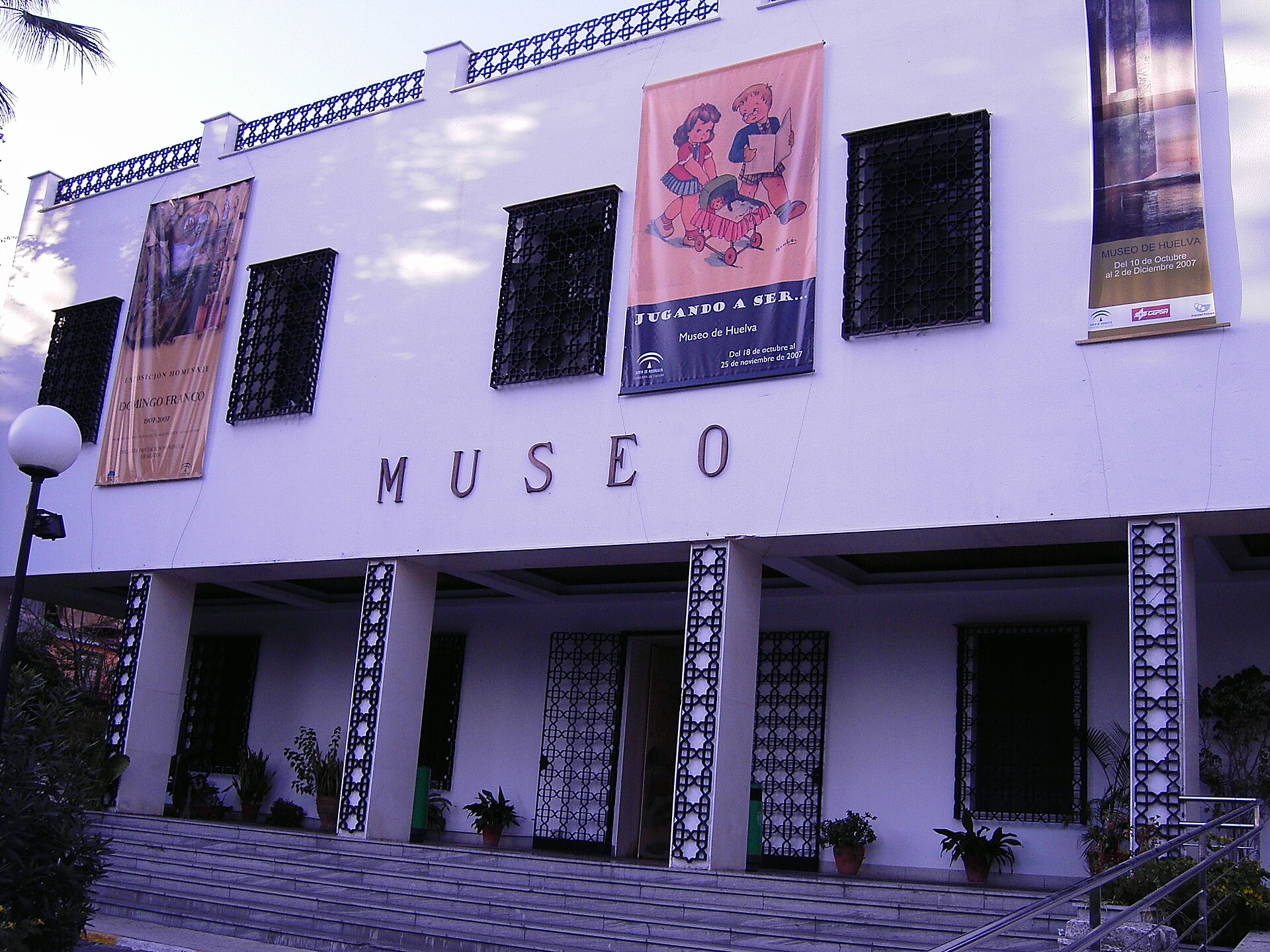
The current museum building has stood on Alameda Sundheim since 1973, purpose-built to house the collection. It is a three-storey structure of roughly 3,000 square metres, with an additional lower-ground floor and an adjoining garden where visitors can pause between galleries. Before this building opened, the museum operated from earlier, temporary premises.
Where did the museum come from?
The Museo de Huelva was formally founded on 7 July 1920 and opened its doors to the public on 25 May 1921. Since then it has steadily expanded its holdings, becoming the main showcase for the archaeological and artistic heritage of the entire province — spanning prehistoric times, the Phoenician and Roman periods, and on into modern art.
When is the best time to visit?
The museum makes an easy addition to a day exploring central Huelva, best paired with a stroll through the surrounding streets. Given how hot Andalusian summers can get, the indoor galleries offer a comfortable break from the midday sun. Plan on roughly ninety minutes to two hours to take in all three sections at a relaxed pace.
Frequently asked questions
Where is the Museum of Huelva located? It sits on Alameda Sundheim in the city of Huelva, in western Andalusia, in an easily reachable part of town.
What is the museum's most notable exhibit? The Roman hydraulic wheel from the Riotinto mines, displayed in the entrance hall, is widely considered one of the collection's signature pieces, alongside the paintings by Daniel Vázquez Díaz.
Is the museum suitable for families with children? Yes — the three themed sections (archaeology, art and ethnography) let visitors pace a visit around different interests, and the layout is easy to walk through with children.
How much time should I set aside? A full visit to all three sections typically takes between 60 and 120 minutes, depending on pace and personal interest.
Nearby places

Earn badges for the places you visit
Download NextOnTrip, discover new places and check off your trails.