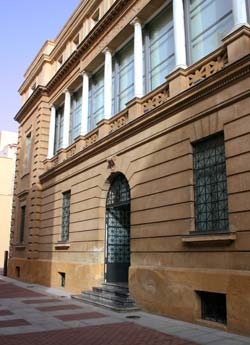
About this place
Museo de Bellas Artes de Murcia (MUBAM) is the leading fine arts museum in Murcia, Spain, holding painting and sculpture that span from the medieval period to the 20th century.
Where did the museum come from?
The institution traces back to 1864, when the Provincial Commission of Monuments established the Museo Provincial, a combined collection that at the time held both artworks and archaeological finds. It was only in 1953, once the archaeological material moved to a separate building — today's Museo Arqueológico de Murcia — that the institution took on its current focus and name, Museo de Bellas Artes de Murcia. The building it now occupies opened in 1910 and underwent a thorough renovation between 2000 and 2005, which brought its infrastructure up to contemporary museum standards.
How is the museum laid out?
MUBAM occupies two linked pavilions. The historic Pabellón Cerdán houses the permanent painting and sculpture collection, while the Pabellón Contraste serves administrative functions, containing offices, a conference hall, and the space used for temporary exhibitions. The permanent display runs across eight rooms arranged in a roughly chronological and thematic sequence: 15th- and 16th-century painting and the Renaissance in Murcia; 17th-century art in the region; Golden Age painting; an 18th-century room covering the Enlightenment period; academicism moving into eclecticism; costumbrista painting and regionalism; and a final room devoted to allegory, decorative painting, and landscape.
What can visitors see in the collection?
The galleries bring together Spanish old masters, including works by Bartolomé Esteban Murillo — among them a Crucifixion and an Ecce Homo — and Francisco de Zurbarán. Alongside these hang paintings by artists with strong regional ties, such as Rafael Tegeo, Martínez Pozo, Medina Vera, and Pedro Orrente. Beyond painting, the museum presents sculpture as well as decorative arts collections covering glass and ceramics, plus a holding of antique book editions. Together, this range traces the development of painting and artistic craft in the Murcia region across several centuries.
Who is this museum for?
Compact yet substantial, MUBAM works well as a half-day cultural stop in central Murcia, and pairs naturally with a visit to the neighboring Museo Arqueológico. The eight themed rooms make it easy to move through Spanish and regional art history at an unhurried pace, and the temporary exhibition space in the Pabellón Contraste means the program is worth checking again on a return visit to the city.
Frequently Asked Questions
What is MUBAM? MUBAM is the abbreviation for Museo de Bellas Artes de Murcia, the city's main fine arts museum, holding painting, sculpture, and decorative arts.
Since when has the museum existed in its current form? The institution began as the Museo Provincial in 1864 and took on its name and focus as Museo de Bellas Artes in 1953, after the archaeological collections were moved to a separate site.
What are the highlights of the collection? Key works include paintings by Murillo and Zurbarán, alongside pieces by regional painters such as Rafael Tegeo and Pedro Orrente.
How many sections does the museum have? MUBAM is made up of two pavilions — the historic Pabellón Cerdán, holding the permanent collection, and the Pabellón Contraste, with offices and a temporary exhibition space — with the permanent display spread across eight themed rooms.
Nearby places

Earn badges for the places you visit
Download NextOnTrip, discover new places and check off your trails.