About this place
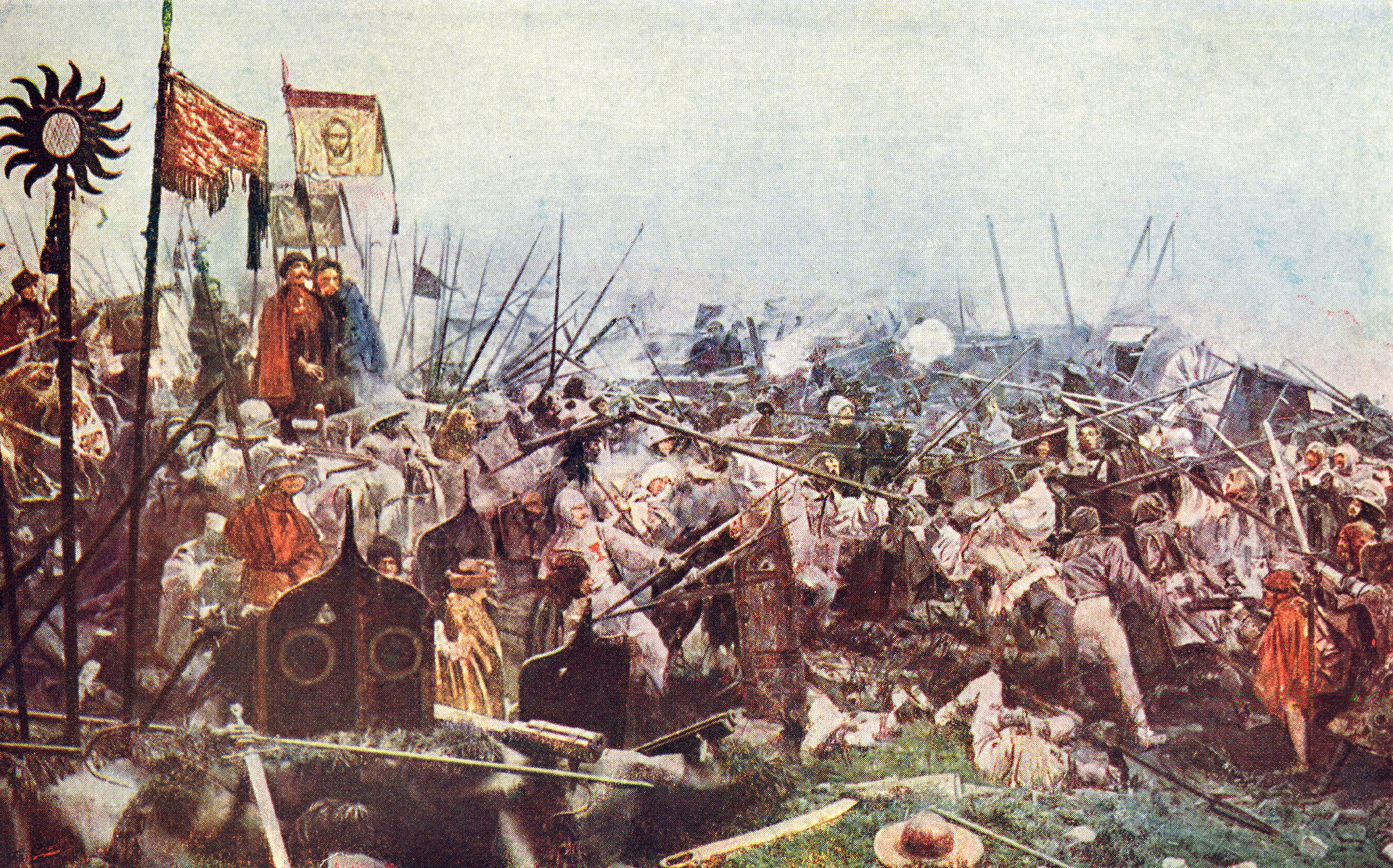
The Marold Panorama is one of Prague's most unusual sights — a colossal circular painting of the Battle of Lipany, housed in its own dedicated pavilion on the Výstaviště exhibition grounds in Holešovice. Unlike a framed canvas hanging on a wall, this painting wraps all the way around the viewer: you stand in the middle of a round hall while the battle scene surrounds you in a full 360-degree circle, creating the illusion of standing right in the middle of the fighting.
The work was created by Luděk Marold, a Czech painter and illustrator who lived from 1865 to 1898 and was best known for his illustrations for Parisian and Prague magazines. In 1897 he proposed painting a monumental panorama of the Battle of Lipany for an upcoming jubilee exhibition in Prague. The proposal was accepted, and after visiting the actual battlefield to make sketches, Marold began painting in early 1898. He did not live to finish it himself — he died later that same year — but the team he had assembled completed the work: landscape painter Václav Jansa handled the backgrounds, Ludvík Vacátko painted the horses and animals, and Karel Rašek, Theodor Hilšer and Karel Štapfer contributed the remaining figures and colouring.
What does the painting show?
The panorama depicts the Battle of Lipany, fought on 30 May 1434 roughly 40 kilometres east of Prague (also known as the Battle of Český Brod). It was one of the decisive clashes of the Hussite Wars: a coalition of Utraquist nobles and Catholics, known as the Bohemian League, defeated the radical Taborite and Orphan factions led by Prokop the Great and cavalry commander Jan Čapek of Sány. The defeat of the radicals effectively ended the Hussite Wars and opened the way to political compromise in Bohemia. Marold recreated the moment with real ambition — hundreds of figures, horses in full gallop, smoke and chaos — all rendered with close attention to historical and military detail.
How big is the painting?
The panorama measures 11 metres high and 95 metres long, making it the largest painting in the Czech Republic and one of the few surviving panoramic paintings of this scale anywhere in the world. The sheer size is striking the moment you step into the hall: the canvas surrounds visitors on every side, with lighting and perspective tricks that heighten the sense of depth and distance.
A turbulent history
The painting's history has been almost as dramatic as the battle itself. The original pavilion built to house it was demolished as early as 1908, forcing a reconstruction of the display. A second blow came in 1929, when the new pavilion collapsed, badly damaging the canvas. Restoration took years, and it was not until 1934 that the panorama could once again be admired in its full glory. It has remained on permanent display at Výstaviště ever since.
How to get there?
The panorama sits at U Výstaviště 1 in Prague's Holešovice district, right next to Stromovka Park and the Výstaviště exhibition grounds. The easiest way to reach it is by tram to the Výstaviště Holešovice stop, served by several lines including 5, 12, 14, 15 and 17 — from there it's about a 5-minute walk to the pavilion.
When to visit?
The panorama operates seasonally, from April to September, Thursday through Sunday, with opening hours from 9:00 to 12:30 and 13:00 to 17:30. It is typically closed outside this window, so it's worth checking current hours before planning a visit, especially outside the main tourist season.
Frequently asked questions
Is it really a full 360-degree panorama? Yes — the painting encircles visitors completely, making it one of the few surviving cyclorama-scale panoramas in Central Europe.
How long does a visit take? Most visitors spend around 20–30 minutes viewing the panorama, though it's worth lingering to pick out details in different sections of the scene.
Can it be combined with other sights nearby? Yes — the pavilion borders the Výstaviště exhibition grounds and Stromovka Park, so a visit pairs easily with a walk through Holešovice's green spaces.
Who painted it? The main author was Luděk Marold, who designed the composition and began work in 1898; after his death, a team of collaborating painters specialising in landscape, animals and colouring finished the piece.
Nearby places

Earn badges for the places you visit
Download NextOnTrip, discover new places and check off your trails.