About this place
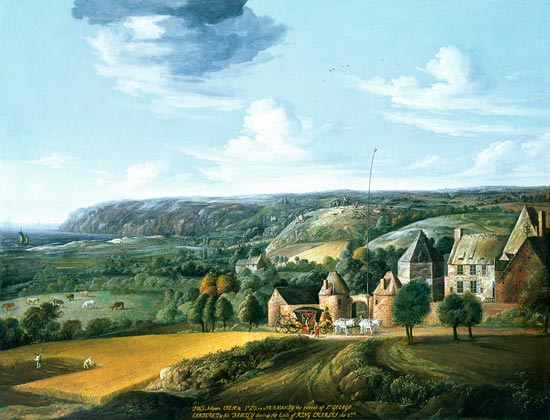
Manoir de Potrel stands in Dragey-Ronthon, a quiet commune on the Manche coastline overlooking the Bay of Mont-Saint-Michel. Tucked half a kilometre west of the village of Dragey, this fortified manor packs several centuries of Norman and even transatlantic history into a modest cluster of stone buildings.
How old is the manor and what remains of its original structure?
The oldest parts of the estate date back to the 15th and 16th centuries, when it functioned as a fortified farmstead. Two surviving features hint at that defensive past: a courtyard gateway flanked by a pair of rounded turrets pierced with narrow loophole slits, and a separate dovecote built on an octagonal plan. Fortified farms of this kind were common among wealthy Norman landowners who needed to protect livestock and stores during unsettled times.
Why is a manor in rural Normandy linked to the founding of North Carolina?
The estate's most notable owner arrived in the 17th century: George de Carteret (1609-1679), bailiff of Jersey and a vice-admiral in the Royal Navy, bought Potrel while living in exile in France. Carteret later became one of the eight Lords Proprietor granted the American colonies of Carolina and New Jersey by the English Crown — a detail that gives this quiet Norman manor an unexpected place in colonial American history. The grander, more comfortable wing of the manor was built or refitted under his ownership, including an upstairs reception hall finished with wood panelling and painted ceiling beams dated to the third quarter of the 17th century.
What legal protection does the building have?
Since November 27, 1933, the fireplaces, panelling, and ceiling of that upstairs hall have been listed as a monument historique. The protection covers this specific interior rather than the whole property, and the manor itself remains privately owned.
Is it possible to visit the interior?
No public opening hours are documented for Manoir de Potrel, and as private property it does not appear to offer regular tours of the interior. Visitors passing along the road toward Dragey can still see the fortified gateway and dovecote from outside, which makes the site a worthwhile stop for anyone tracing Normandy's smaller-scale defensive architecture rather than its famous castles.
What else is worth seeing around Dragey-Ronthon?
The commune sits on a sandy beach stretching nearly 6 kilometres along the Bay of Mont-Saint-Michel; from its southern end, the abbey itself is visible on clear days, though swimming is really only practical around high tide. Two other historic buildings round out the local heritage trail: the 11th-century church of Saint-Médard, also known as Saint-Marc, and the 12th-century church of Saint-Nicolas in the Ronthon section of the commune. Away from the coast, Dragey-Ronthon keeps a distinctly rural feel, with dairy farms and a modern training centre for racehorses that opened in 2014.
Drivers based near Mont-Saint-Michel can reach the manor in about 45 minutes, since the two sites sit roughly 36 kilometres apart — an easy pairing for a single day trip along the bay.
Frequently asked questions
Can visitors go inside Manoir de Potrel? Not currently — it is private property with no confirmed public tours. The gateway towers and dovecote can be viewed from the public road.
Who was the manor's most historically significant owner? George de Carteret, a Royal Navy vice-admiral who bought the estate in the 17th century and went on to co-found the American colonies of Carolina and New Jersey.
What part of the manor is officially protected? Since 1933, the fireplaces, panelling, and ceiling of the first-floor reception hall have held listed status as a monument historique, distinct from the rest of the privately owned property.
How far is Manoir de Potrel from Mont-Saint-Michel? Around 36 kilometres, roughly a 45-minute drive, making it a convenient stop for travellers exploring the bay area.
Nearby places

Earn badges for the places you visit
Download NextOnTrip, discover new places and check off your trails.