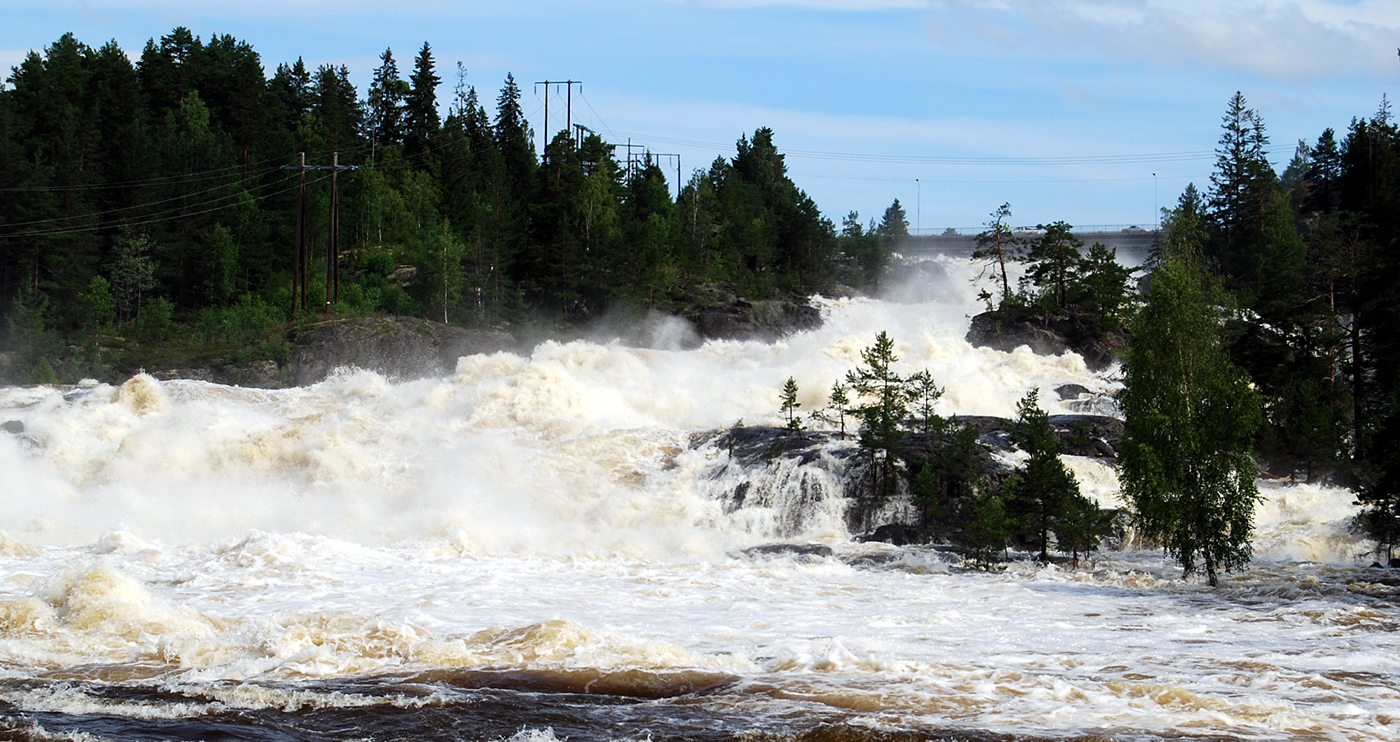
About this place
Labrofossen is a waterfall in Kongsberg municipality in southern Norway, on the Numedalslågen river about five kilometres south of the town centre. The Norwegian encyclopedia gives its height as roughly 41 metres. It is a spot where nature, the industrial history of the valley and national romantic painting meet within a small area.
Where is Labrofossen and how do you find it?
The falls lie in Kongsberg, a former mining town in Buskerud county, in the Numedalslågen valley, one of the larger rivers of eastern Norway. They sit about five kilometres downstream from the centre, so a visit is easy to combine with a stay in town. Sources use two spellings, Labrofossen and Labrufoss. Both refer to the same waterfall, and the first is more common in museum catalogues and on tourist maps.
Where does the name come from?
The Norwegian encyclopedia suggests that the first part of the name may derive from an Old Norse word for a place where cargo was loaded onto boats. This is a hypothesis rather than a certainty. The river was an important transport route for centuries, so the interpretation fits the character of the area.
How is the waterfall tied to hydropower?
The river's drop here was harnessed to generate electricity. The Labro power station began operating in 1910. In 1983 it was replaced by the Skollenborg power plant, which combines the drop at Labrufoss with the nearby Gravenfoss waterfall. That makes Labrofossen a good example of how Norwegian hydropower shaped both the landscape and the economy of the valley.
Why did painters love it?
The waterfall was a frequent subject for artists of the national romantic era. J. C. Dahl, Thomas Fearnley and Hans Gude all painted it, and their works are held by the Nasjonalmuseet in Oslo. Fearnley's oil painting from 1837 is catalogued by the museum as "Labrofossen at Kongsberg." For art lovers it is a rewarding pairing: see the paintings in a gallery, then compare them with the real view.
What else is nearby?
The Labro museum complex stands at the falls: Norsk Vassdragsmuseum (the Norwegian water management museum), Numedalslågens Fløtingsmuseum (the log floating museum) and Norsk Vegmuseum (the road museum). Together they tell how Norwegians used rivers, forests and transport routes. They make a good addition to a short walk by the water, especially for anyone interested in the history of technology.
Frequently asked questions
How tall is Labrofossen? The Norwegian encyclopedia gives about 41 metres.
Are Labrofossen and Labrufoss the same place? Yes, they are two spellings of the same waterfall in Kongsberg.
Is the waterfall connected to a power station? Yes. The Labro power station operated here from 1910 and was replaced by Skollenborg in 1983.
Who painted Labrofossen? Among others J. C. Dahl, Thomas Fearnley and Hans Gude.
Where can you see paintings of the falls? In the collection of the Nasjonalmuseet in Oslo.
What can you visit next to the waterfall? The Labro museums, devoted to water management, log floating and roads.
Earn badges for the places you visit
Download NextOnTrip, discover new places and check off your trails.