About this place
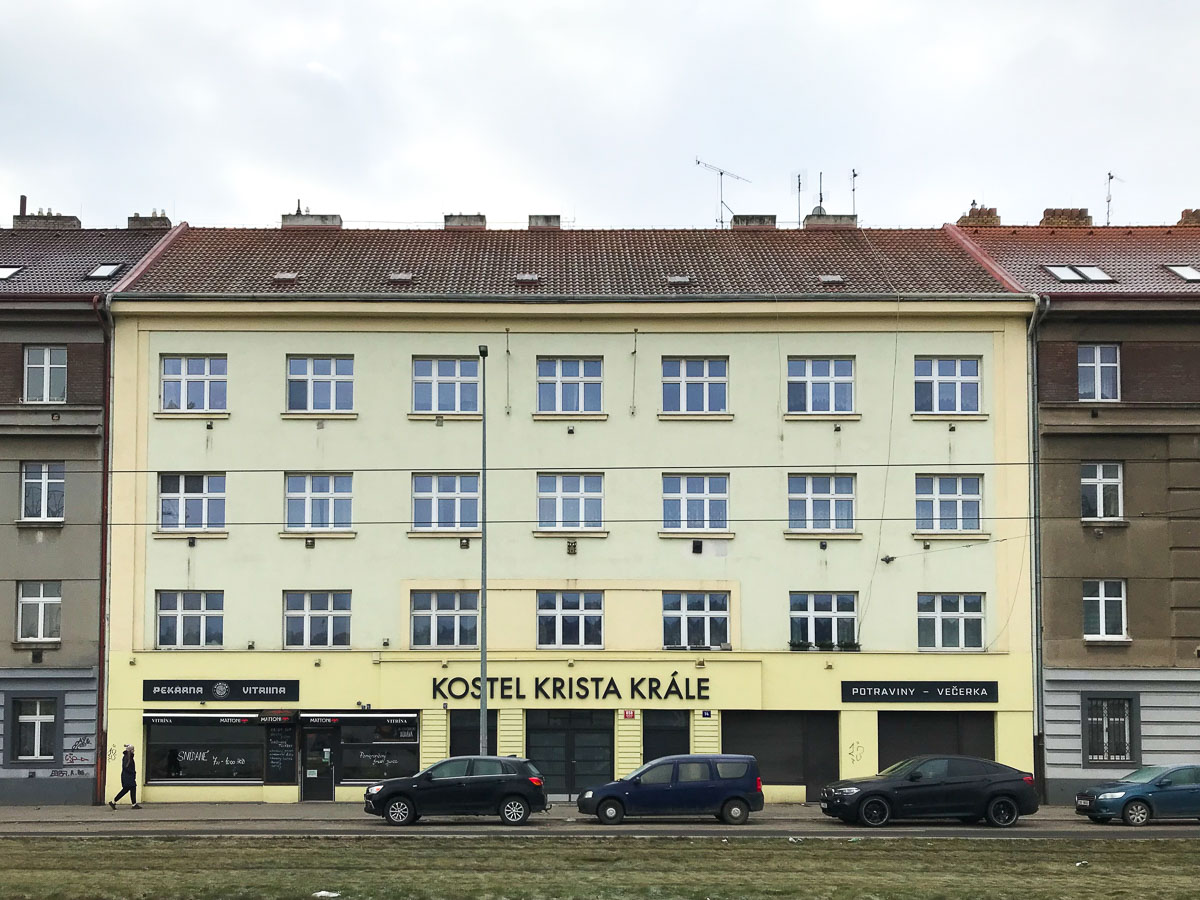
Kostel Krista Krále (Church of Christ the King) is a functionalist Roman Catholic church tucked away in Prague's Vysočany district (Prague 9) — a building most visitors would walk straight past without ever knowing it's there.
Why is this church so easy to miss?
The church sits inside a pentagon-shaped block of apartment buildings, boxed in by the streets Kolbenova, Špitálská, Zákostelní and Nemocniční. The only clue at street level is a sign reading "Kostel Krista Krále" above the entrance of a three-storey residential building at Kolbenova 658/14 — that entrance leads through to the inner courtyard where the church actually stands. The courtyard itself isn't open to the general public, which is why the church is often described as one of Prague's more hidden places of worship.
When was it built, and by whom?
The foundation stone was laid on 6 October 1929, with the design and construction carried out by the Nekvasil building and design firm, associated with Bedřich Vrzal. Work moved fast: less than a year later, on 7 September 1930, Bishop Antonín Podlaha consecrated the finished building. The result is a single-nave church with a flat ceiling, a projecting rectangular presbytery and a small tower — a modest, functional form typical of interwar Czechoslovak sacred architecture.
What's inside worth seeing?
The interior holds a handful of notable artworks. Sculptor Damián Pešan created the statue of Christ the King along with statues of St. Peter and St. Paul in the presbytery, while the main nave holds figures of St. Agnes of Bohemia, St. John of Nepomuk, St. Anthony, St. Joseph, St. Ludmila and St. Adalbert (Vojtěch) — later joined by statues of St. Procopius and St. Vitus. Zikmund Rudl painted the Stations of the Cross as well as images of St. Wenceslas and the Virgin Mary for the side altars. One quirky detail: the church displays an unconventional ceramic nativity scene during the Christmas season.
Is it a protected monument?
Yes — the church has been listed as a protected cultural monument since 22 October 2003. By 2009 it had undergone a substantial round of repairs, funded by the city and the Prague 9 district: the original 1930 electrical wiring was replaced, and the exterior walls were restored with new windows made to match the building's original style.
Frequently asked questions
Can you see the church from the street? Not really — from outside, the only giveaway is the sign above the entrance to the residential building at Kolbenova 658/14, since the church itself stands in an inner courtyard that isn't open to the public.
When was the church built? The foundation stone was laid in October 1929, and the building was consecrated on 7 September 1930.
What architectural style is it? Functionalism — a single-nave structure with a flat ceiling, a projecting rectangular presbytery and a small tower, typical of Czech interwar sacred architecture.
Is the church a listed heritage site? Yes, it has held protected cultural monument status since 2003, and later underwent a full restoration of its facade and electrical systems.
Who created the artwork inside? The sculptures are the work of Damián Pešan, while the paintings, including the Stations of the Cross, were created by Zikmund Rudl.
Nearby places

Earn badges for the places you visit
Download NextOnTrip, discover new places and check off your trails.