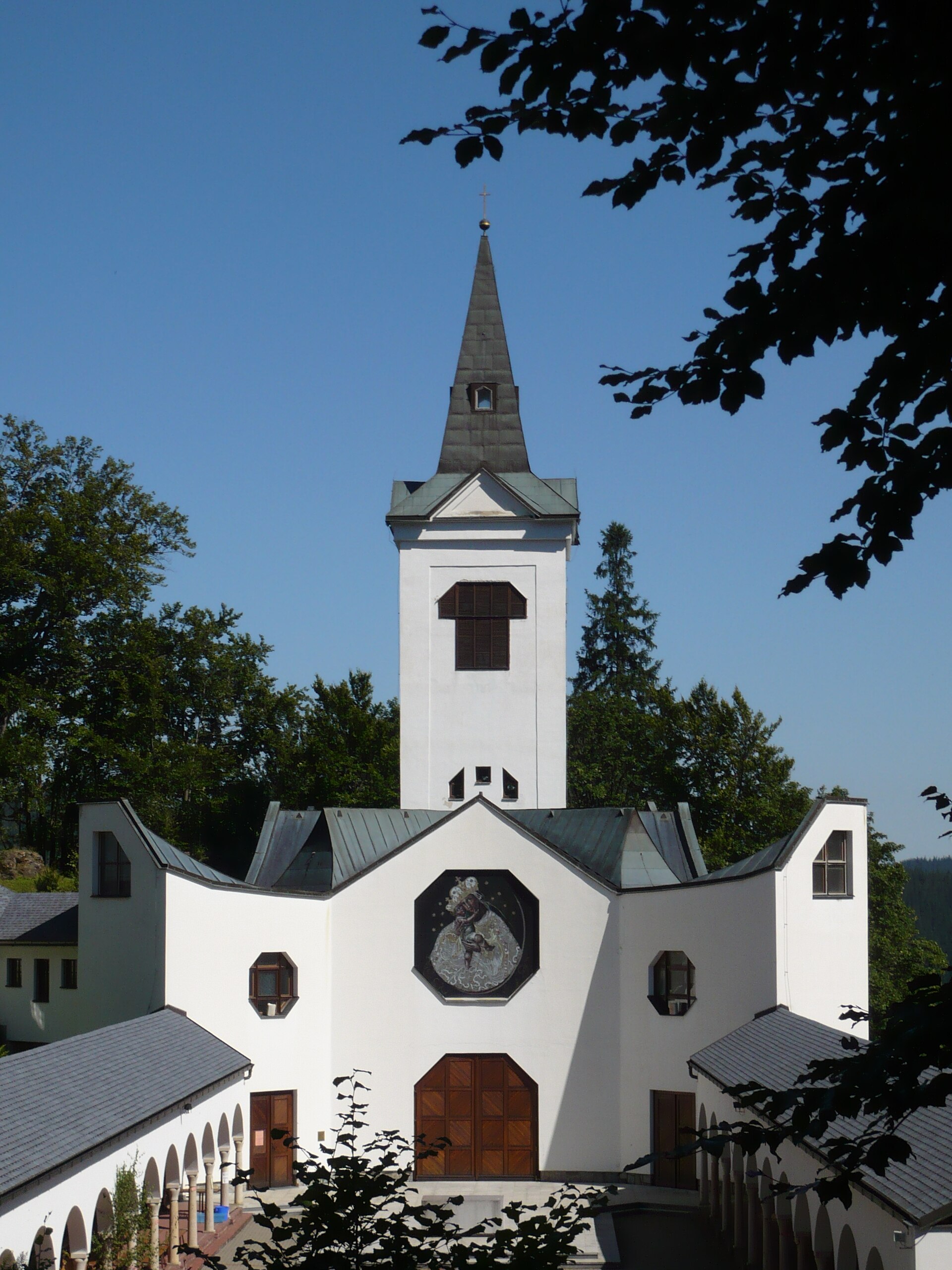
About this place
The Church of Our Lady Help of Christians – Maria Hilf stands on the eastern slope of Příčný Hill (Góra Poprzeczna), in the southern part of Zlaté Hory, in the Czech section of the Opava Mountains (Jeseník district, Olomouc Region). For nearly three centuries the site has drawn pilgrims from across the Czech-German-Polish border region.
Why is the shrine called Maria Hilf?
The story behind the name goes back to the Thirty Years' War. According to local tradition, when Swedish troops advanced into the area, a pregnant woman named Anna Tannheiserová fled to the nearby God's Mountain and gave birth alone to a son, Martin. Grateful for surviving, she stipulated in her will that an image of the Virgin Mary be placed at the spot where she had taken refuge — the origin of the German name Maria Hilf, "Mary Helper."
When was the present-day church built?
A wooden chapel first went up on the hillside in the first half of the 18th century and was later rebuilt into a church. The cornerstone of a proper masonry pilgrimage church was laid in 1834, and the building was consecrated on 8 September 1841, the feast of the Nativity of the Virgin Mary — a date that has anchored the site's main pilgrimage ever since.
What happened to the church under communist rule?
Services continued uninterrupted until 1955, when the communist authorities banned pilgrimages and shut down worship at the site. Left without care, the church fell into disrepair, and in 1973 it was dynamited and razed to the ground. For close to two decades, little more than the bare hillside remained where the shrine had stood.
How was the pilgrimage site revived after 1990?
Following the fall of communism, a preparatory committee was formed already in 1990 to rebuild the shrine on Příčný Hill. Thanks to the involvement of believers from the Czech, Polish, and German borderlands, the site gradually regained its former standing and today again functions as an active Marian shrine.
What draws pilgrims to Maria Hilf today?
The highlight of the annual calendar is the September Pilgrimage of Three Nations, which brings together the faithful and clergy from the Czech Republic, Germany, and Poland — the single largest gathering the shrine sees each year. Beyond the main pilgrimage, the site also serves as a stop for hikers and cyclists exploring the Opava Mountains, combining spiritual significance with a scenic setting on a wooded hillside.
Frequently asked questions
Where exactly is the Maria Hilf church located? On the eastern slope of Příčný Hill, in the southern part of Zlaté Hory, in the Jeseník district of the Olomouc Region, Czech Republic.
Where does the name Maria Hilf come from? From the legend of Anna Tannheiserová, who took refuge here during the Thirty Years' War and, in her will, asked for an image of the Virgin Mary Helper to be placed at the site.
Is the church standing today the original building? Not entirely — the original 1841 church was demolished by the communist authorities in 1973; the present shrine was rebuilt after 1990.
When does the main pilgrimage take place? In September, during the Pilgrimage of Three Nations, which gathers pilgrims from the Czech Republic, Germany, and Poland.
Is it worth combining a visit with a hike in the area? Yes — the shrine sits along hiking routes through the Opava Mountains, making it easy to pair with exploring the countryside around Zlaté Hory.
Nearby places
-

Church of the Name of the Virgin Mary
Złote Góry
-
Church of Saint Michael (Vrbno pod Pradědem)
Vrbno pod Pradědem
-
Cemetery in Vrbno pod Pradědem
Vrbno pod Pradědem
-
Church of the Visitation of Our Lady (Ludvíkov)
Ludwików
-
Sloup se sousoším Nejsvětější Trojice
Jesionik
-
Church of the Assumption
Jesionik
Earn badges for the places you visit
Download NextOnTrip, discover new places and check off your trails.