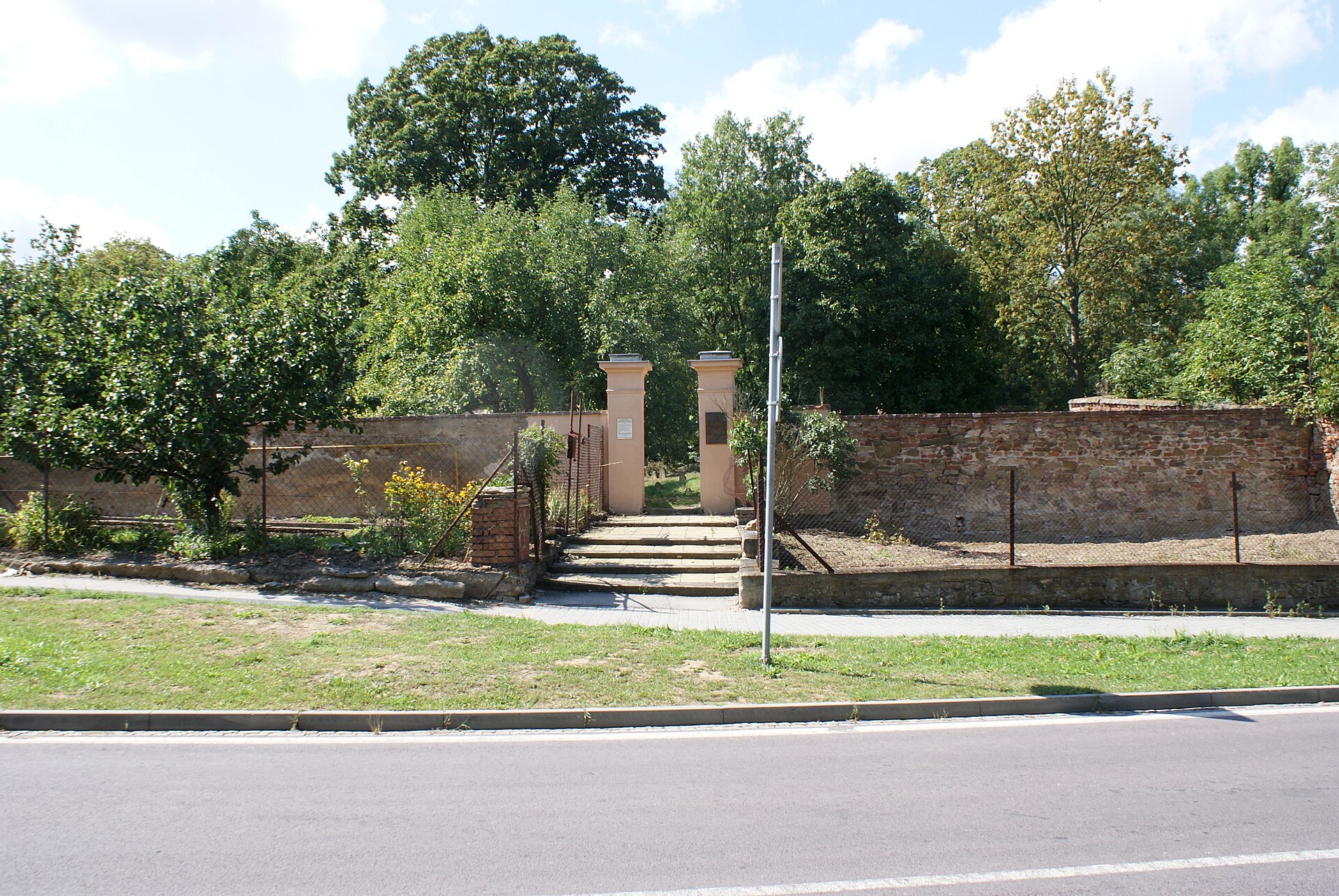
About this place
The Jewish cemetery in Moravský Krumlov stands as one of the most significant surviving traces of a Jewish community that shaped this South Moravian town for centuries. The burial ground lies southwest of the town centre, near the junction of Ivančická and Znojemská streets, spread across a plot of more than 8,000 square metres.
When was the cemetery established?
The exact founding date is not documented, but the site was in use no later than the 16th century, reflecting the presence of an organised Jewish community in the town from an early period. The oldest fully legible tombstone bears the date 1613, although some records point to 1653 as the point from which inscriptions can be read with full certainty.
How did burials develop over time?
For more than three centuries, generations of Jewish residents from the town and surrounding villages were laid to rest here. The largest surviving group of gravestones dates from the 17th and 18th centuries, a period that left behind the richest material record of the community's life. The very last burial took place in December 1937, shortly before the events that would bring an abrupt end to organised Jewish life in the town — the local community formally ceased to exist in 1938.
What structures remain on the grounds?
At the start of the 20th century, a new mortuary building was constructed on the cemetery grounds, complete with a carriage shed and a caretaker's apartment. These structures lost their original purpose after the Second World War and were converted into residential housing between 1959 and 1961. Today the cemetery preserves roughly 407 gravestones, of which about 250 remain legible. Among them are memorials dedicated to prominent rabbis and community leaders, evidence of the standing this congregation once held in the region.
What condition is the cemetery in today?
Following the Holocaust, which abruptly ended centuries of continuous Jewish life in Moravský Krumlov, the cemetery fell into decades of neglect and was gradually overtaken by vegetation. Fragile, centuries-old headstones became overgrown with brush, weeds, and ivy. In recent years, the situation has improved thanks to the efforts of private individuals — descendants of families connected to the town, living in nearby villages, who have dedicated many hours to clearing and restoring the site. Basic maintenance is also handled by the Jewish community of Brno, though the scope of conservation work still needed exceeds what these efforts alone can achieve.
Frequently asked questions
How many gravestones survive at the cemetery? Around 407 gravestones remain on the site today, of which approximately 250 are still legible.
What is the date of the oldest gravestone? The oldest fully legible gravestone is dated 1613, though some sources cite 1653 as the first date read with complete certainty.
When did the last burial take place? The final burial at the cemetery occurred in December 1937.
Can visitors tour the cemetery? Yes, the site can be visited as a historical monument and place of remembrance, though visitors should treat it with the solemnity such a location deserves.
Who maintains the cemetery today? Basic upkeep is provided by the Jewish community of Brno, supplemented by private restoration efforts from individuals connected to the town's former Jewish families.
Nearby places

Earn badges for the places you visit
Download NextOnTrip, discover new places and check off your trails.