About this place
Hradiště is a small but ecologically significant nature monument on the Central Bohemian Upland, tucked between the villages of Dřínov, Zlonice and Bakov in the Kladno district. Its name recalls a former hillfort once believed to have stood here, though today the site is known mainly as a refuge for heat-loving steppe vegetation that has become rare across this part of the Czech Republic.
Where exactly is Hradiště located?
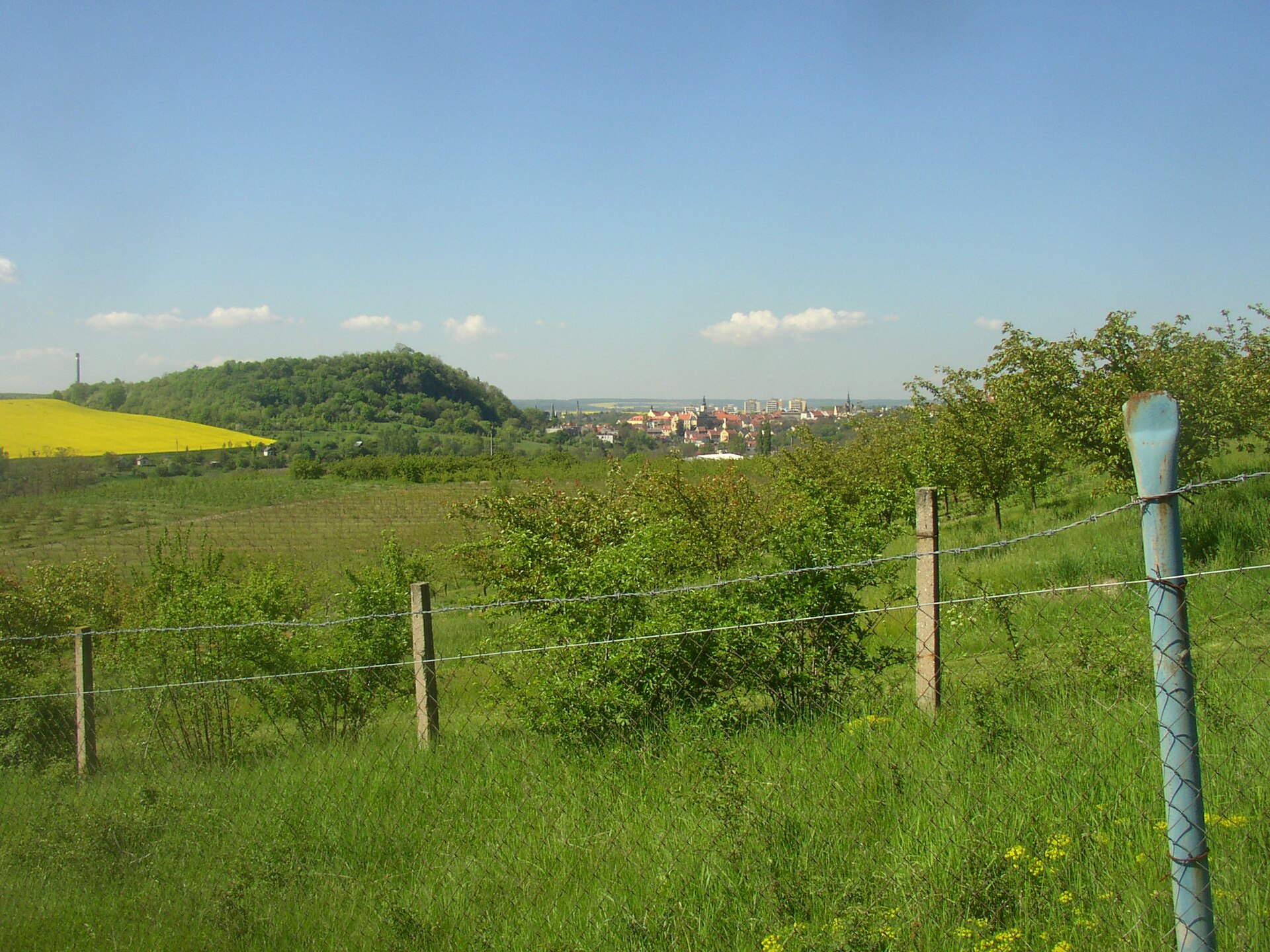
The protected area forms a narrow strip, just over five hundred metres long and roughly fifty metres wide, running along a south-facing slope that drops toward the valley of the Bakovský stream. Its eastern edge is bordered by road II/118, which connects the towns of Slaný and Zlonice. The site sits at an elevation of 280 to 290 metres above sea level, and the combination of southern exposure and moderate altitude gives the slope an unusually warm, dry microclimate for the region.
When and why was the area protected?
The site was declared a nature monument on 25 July 1990 by decision of the then Kladno District Office. The protected area covers only 2.85 hectares, yet its ecological value is disproportionately large for its size. Internationally, it is classified under IUCN Category IV, meaning it is managed specifically to protect the habitat of particular species and plant communities rather than the landscape as a whole.
What does the reserve protect?
The conservation focus is on heat-loving grassland and shrub communities that develop on limestone slopes. These steppe-like meadows are among the most threatened habitat types in the Czech Republic: they depend on very specific soil and climate conditions, yet without regular management such as grazing or mowing, they are quickly overtaken by shrubs and woodland. The dominant plant here is tor-grass (Brachypodium pinnatum), which forms dense, characteristic swards across the slope. The reserve is also home to Coronilla vaginalis, a coronilla species tied to warm, lime-rich soils and considered locally rare. Such dry grasslands provide shelter for numerous heat-loving invertebrates and other animals adapted to a sun-baked, arid microclimate that most of Central Europe's cooler, damper landscapes cannot offer.
Where does the name Hradiště come from?
The site's name derives from a former hillfort that, according to local tradition, once stood in this area. Elevated ground with steep, south-facing slopes above stream valleys was historically a favoured location for fortified settlements, since the terrain naturally hindered access from the valley side while offering good visibility over the surrounding countryside. No visible traces of that settlement remain on the surface today, but the name has survived in local toponymy and now identifies the nature monument itself.
What should visitors know about nearby Dřínov?
The village of Dřínov, within whose administrative boundaries the reserve lies, is a small settlement of around 335 residents, located roughly fifteen kilometres north of Kladno and five kilometres northwest of Slaný. The municipality consists of two parts, Dřínov and Drchkov. The first written record of the village dates back to 1316. The village has a Church of Saint Luke, near which stands a well-known old linden tree called the Dřínovská lípa.
Frequently asked questions
Can visitors enter the Hradiště reserve? As a legally protected nature monument, the site should be explored only along existing paths, and plants should not be picked, in order to avoid damaging the sensitive steppe grasslands.
What is the main highlight of the reserve? The steppe vegetation itself is the main draw — dense tor-grass swards and stands of the rare Coronilla vaginalis, best seen in spring and early summer.
How do you get to Hradiště? The easiest approach is via road II/118 between Slaný and Zlonice, which runs directly along the eastern boundary of the protected area.
Nearby places

Earn badges for the places you visit
Download NextOnTrip, discover new places and check off your trails.