
Save this place and discover nearby attractions with NextOnTrip
In the app you can add it to your favorites, see what else is worth visiting nearby on the map, and earn a badge for your visit.
The app is available for iPhone and Android.
About this place
Drawa National Park (Drawieński Park Narodowy) is one of Poland's youngest national parks, set in the north-west of the country where three voivodeships meet: Greater Poland, Lubusz and West Pomerania. It was established in 1990 and today protects more than 113 square kilometres of forest, lakes and river valleys. It takes its name from the River Drawa, which runs through the heart of the area.
Where is the park and what does the landscape look like?
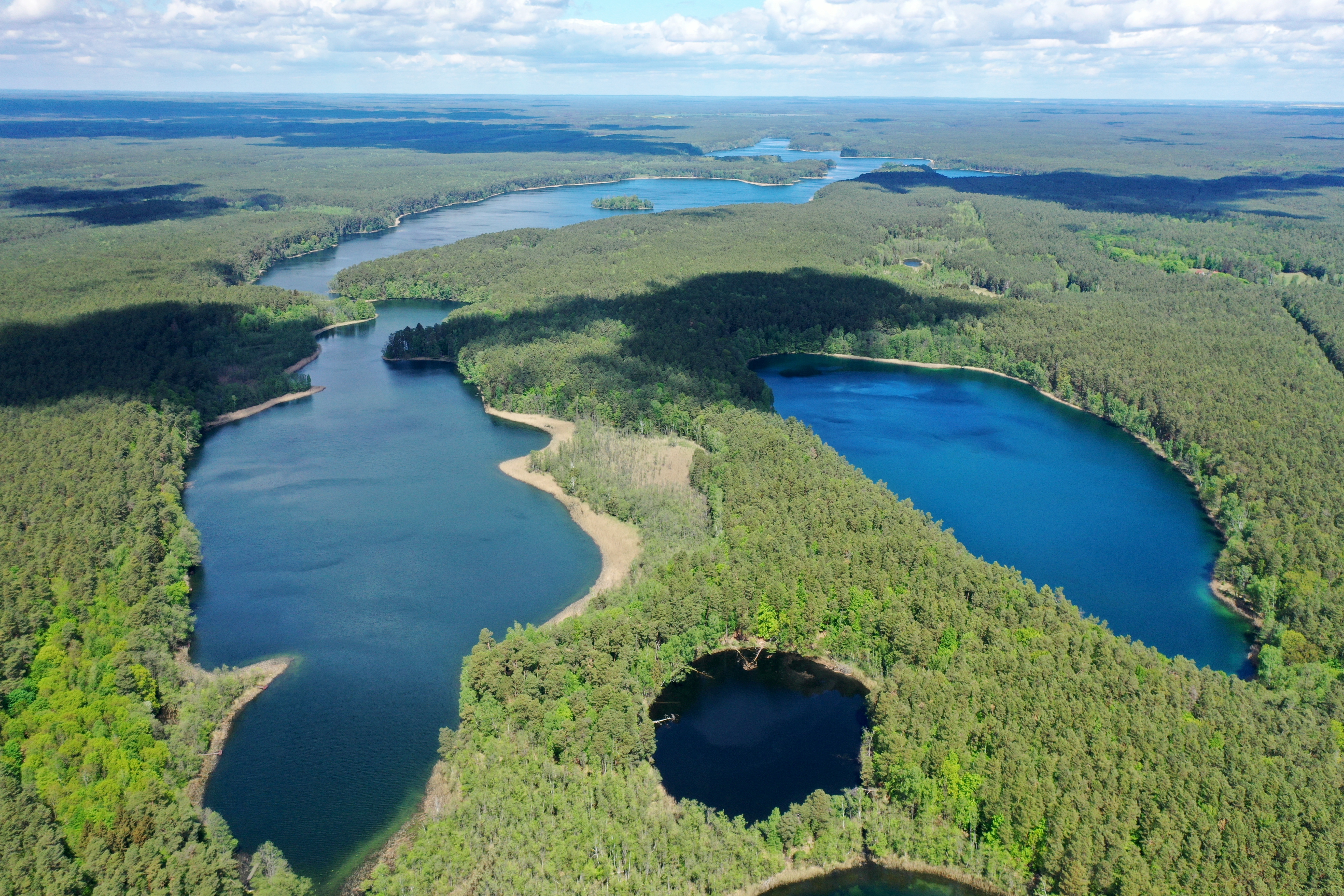
The park lies within the large Drawsko Forest, on the Drawsko Plain. Its territory is V-shaped and takes in the Drawa valley, the Płociczna valley and part of the forest itself. The scenery is a mix of dense woodland, meadows between the trees, lakes and peat bogs. The park sits at roughly 53.1° N, 15.9° E.
How big is it?
When it was created, the park covered about 86.9 km². It was later enlarged to 113.42 km², of which around 96 km² is forest and a little over 9 km² is water. Woodland covers about 80% of the park and includes pine forests, beech and oak-beech forests, alder carr and riparian forests along the water.
What to see: the lakes
Lakes are the park's greatest treasure, and there are about twenty of them. They differ considerably in character:
- Dystrophic lakes, locally called "hungry lakes", sit among peat bogs and have dark water poor in nutrients.
- Eutrophic lakes, rich in nutrients, include Sitno, Płociczno and Ostrowieckie.
- Mesotrophic marl lakes include Marta and Płociowe.
Such a range of lake types in a fairly small area makes the park rewarding for nature lovers as well as for ordinary visitors.
Can you go kayaking here?
Yes. The Drawa is the most popular spot in the park and a favourite with kayakers and rafting fans, thanks to its scenery and fairly fast current. For many visitors the river is the main reason to come.
What wildlife can you see?
The animal most closely associated with the park is the otter, which appears on its emblem. Beavers also live here, and along the water you may spot white-tailed eagles, cormorants and goosanders. Lakes and river banks are the best places to look for birds.
Frequently asked questions
When was Drawa National Park created? In 1990, which makes it one of Poland's youngest national parks.
Which regions is it in? On the border of Greater Poland, Lubusz and West Pomeranian Voivodeships.
How many lakes does it have? About twenty, ranging from peat-bog dystrophic lakes to marl lakes.
Which river flows through it? The Drawa, with the Płociczna valley as the second major river valley in the park.
What animal symbolises the park? The otter, shown on the park's emblem.
Is it good for kayaking? Yes. The Drawa is valued for its picturesque landscape and lively current.
Is it mostly forest? Yes. Forests cover the large majority of the area, including pine, beech, oak-beech, alder and riparian woods.
Who is it for?
It suits anyone who wants quiet, extensive forest and water in many forms. It works as a day trip, or as a longer stay with a kayak, binoculars for birdwatching and a camera. Before you go, check the current visiting rules and notices on the park's official website, since the usual protected-area restrictions apply and some trails or places may be temporarily closed.

Nearby places

Earn badges for the places you visit
Download NextOnTrip, discover new places and check off your trails.