About this place
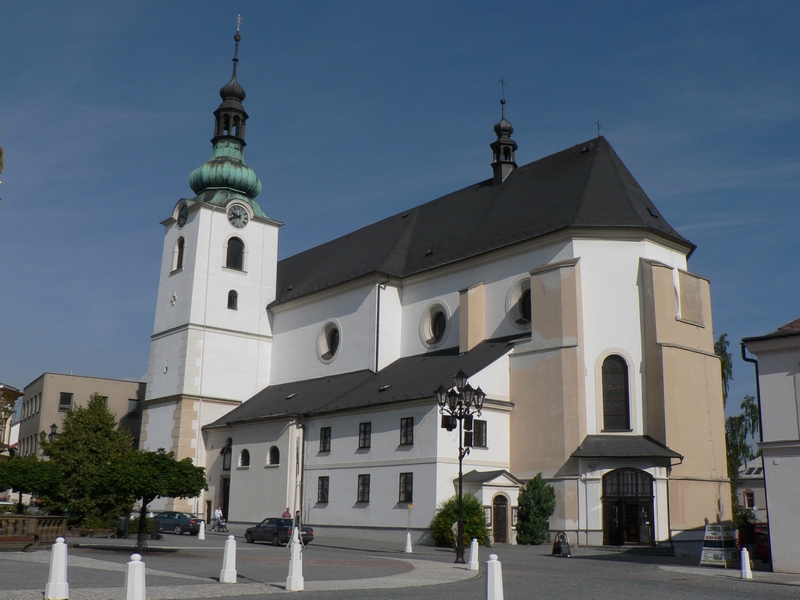
Church of the Visitation of the Virgin Mary, Svitavy
The Church of the Visitation of the Virgin Mary is the main church of Svitavy, standing on Náměstí Míru (Peace Square) in the Pardubice Region of the Czech Republic. Its late Baroque exterior, the one visitors see today, hides a much older story stretching back to the Middle Ages — this is the oldest and most important religious site in town.
When was the church built, and what did it look like originally?
The earliest church on this spot was a Romanesque, single-nave building with two side chapels, raised around the year 1250, during a period when the area around Svitavy was being settled mostly by German colonists brought in to clear forest and found new towns along the Bohemian-Moravian border. From the start, the church served as the religious center of the growing settlement that would later become a town.
What role did it play during the Hussite Wars?
During the Hussite Wars the church found itself at the center of the region's turmoil. The Litomyšl chapter of canons took refuge inside it, fleeing the threat posed by Hussite forces. The respite did not last: in 1424, Hussite troops plundered the town, and the church suffered serious damage in the process, leaving a long mark on the building and its parish.
What connected the church to the Premonstratensians?
After the Hussite upheavals, a hospital run by the Premonstratensian order operated next to the church, linked to it by an underground passage. A church, monastic grounds, and a shelter for the sick or for travelers combined in one complex was a common arrangement for medieval religious centers of this size, and it points to the standing the church held among the people of Svitavy at the time.
Why does the church look Baroque today?
A turning point in the building's history came with the fire of September 4, 1781 — the largest the town has ever suffered. The blaze consumed a large part of the town, the church included, leaving it to be rebuilt almost from scratch. Work carried out between 1783 and 1795, led by the Litomyšl builder Matěj Rosa, gave the church the late Baroque form it retains today, shaping its mass, tower silhouette, and interior.
What is worth seeing inside?
Inside, the altar paintings by Georg Töniger and Hubert Maurer stand out, created as part of the church's Baroque decoration. Another valuable feature is the organ from 1798, built by master craftsman Johann Staudinger — an instrument that has survived to the present day and still forms part of the church's furnishings. A further thorough renovation took place in 1993–1994, keeping the building in good technical condition.
Where exactly does the church stand?
The church sits on Náměstí Míru, the main square of Svitavy, making it a natural landmark in the town center. Svitavy has a second church, dedicated to Saint Joseph — a separate building, not to be confused with the Church of the Visitation of the Virgin Mary described here.
Frequently asked questions
Where is the Church of the Visitation of the Virgin Mary in Svitavy? It stands on Náměstí Míru, the main square of Svitavy, in the Pardubice Region of eastern Bohemia.
How old is the church? Its oldest part dates to around 1250, when a Romanesque, single-nave church with two side chapels was built on the site.
Why does the church have a Baroque appearance? After the fire of 1781, the largest in the town's history, the church was rebuilt between 1783 and 1795 in the late Baroque style under the direction of Matěj Rosa of Litomyšl.
What can be seen inside the church? Altar paintings by Georg Töniger and Hubert Maurer, plus an organ from 1798 built by Johann Staudinger.
Is this the same church as Saint Joseph's in Svitavy? No — it's a separate, second church in town. The Church of the Visitation of the Virgin Mary is the main parish church on Náměstí Míru.
What was the church's connection to the Premonstratensian order? A Premonstratensian-run hospital operated next to the church, linked to it by an underground passage — a typical arrangement for medieval religious centers of this kind.
Nearby places

Earn badges for the places you visit
Download NextOnTrip, discover new places and check off your trails.