- Sacred Monuments
- Churches
Church of the Assumption of the Virgin Mary (Moravský Beroun)
About this place
The Church of the Assumption of the Virgin Mary in Moravský Beroun is a Renaissance-era church that has crowned the skyline of this small town in the Olomouc District, Olomouc Region, in eastern Czechia, for more than four centuries.
When was the church built?
Construction dates to 1607-1610. The founder was Prince Karel of Münsterberg, who built it as a Lutheran church dedicated to the Holy Trinity. The choice of a Protestant dedication was no accident: at the time, much of Silesia and the Moravian-Silesian borderland lay under strong Reformation influence, and local nobles frequently funded Protestant places of worship.
Why was the dedication changed to the Assumption?
The religious landscape shifted after the Protestant defeat in the Thirty Years' War. In 1672, during a building repair carried out alongside the region's recatholicization, the church received the dedication it still carries today - the Assumption of the Virgin Mary. The change in patronage mirrored Habsburg religious policy of the period, which systematically restored Catholicism in territories previously dominated by Lutheranism.
What does the church's architecture look like?
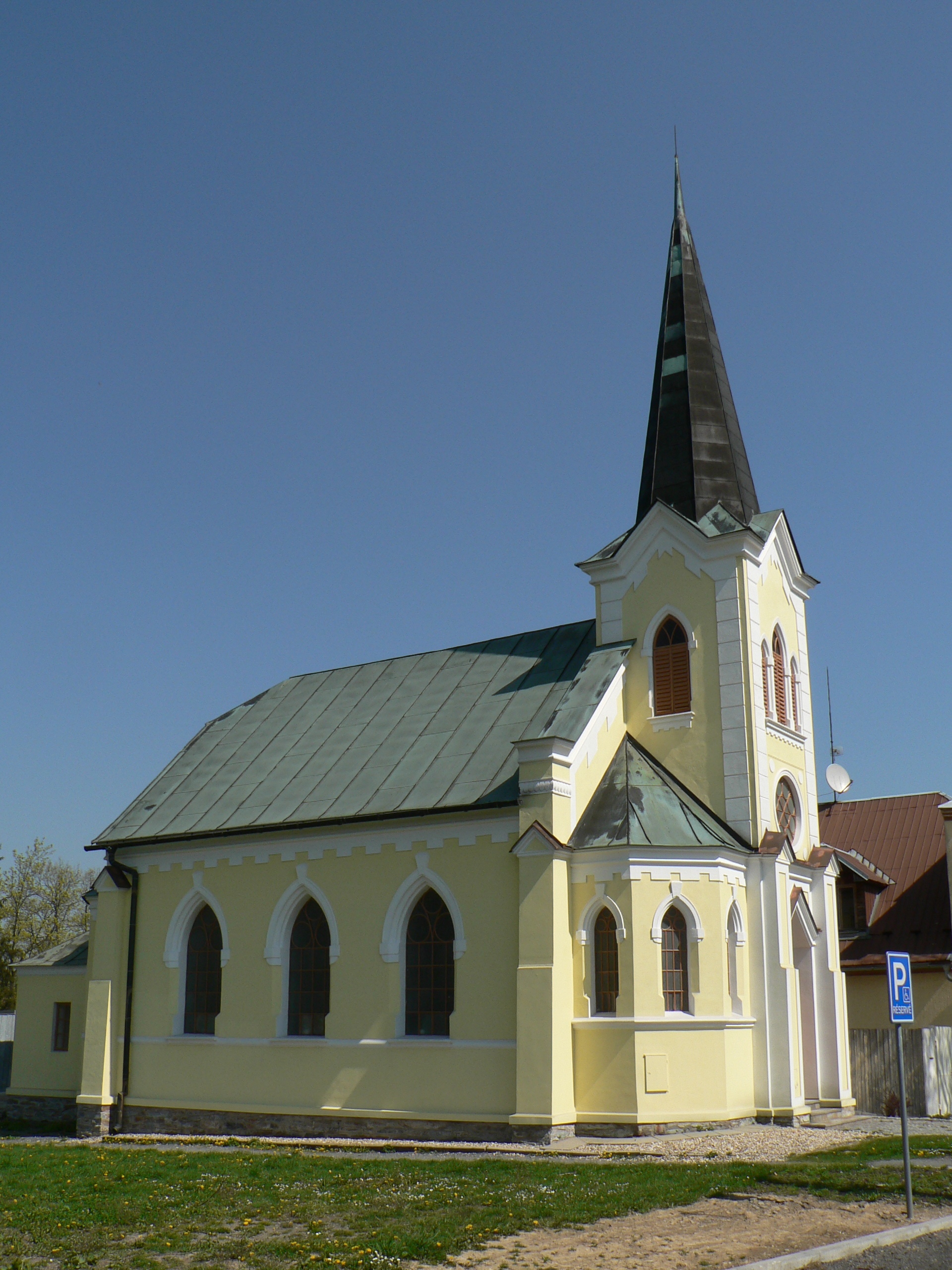
The building is a three-aisled hall church in a transitional style between Gothic and Renaissance, with an elongated, polygonally closed chancel. In the corner between the northern aisle and the chancel stands a distinctive tower topped with a pyramidal spire, flanked by an external cylindrical staircase - a rare and easily recognizable feature from outside.
Inside, the original galleries survive, typical furnishings for Protestant churches of the period, designed to accommodate a larger congregation on an upper level of the nave. Their survival despite the later recatholicization of the building is unusual and a valuable trace of the church's Lutheran past.
What is worth seeing inside?
Most of the interior furnishings date from the 18th and 19th centuries. Between the buttresses of the chancel, on the church's central axis, stands a grotto depicting Christ in the Garden of Gethsemane, dated to 1750 - one of the more striking pieces of folk sacred art in the region. The stone baptismal font dates from the late 17th century, making it older than most of the remaining furnishings and likely predating the change of dedication.
The tower bell was cast in 1584 and originally came from the village of Jestřebí, which no longer exists - making it one of the oldest elements of the entire furnishing, older even than the church building itself. The church is also known for having some of the oldest organs in Moravia, which makes it a notable stop for anyone interested in sacred music or the history of church instruments.
Why is this church worth a visit?
The Church of the Assumption dominates the visual landscape of Moravský Beroun; its tower is visible from most points in town. For visitors, it layers three periods of history in a single building: its Protestant origin in the early 17th century, Baroque-era recatholicization and 18th-19th century decoration, and even older relics such as the 16th-century bell. It is a rare example of a church that legibly preserves traces of the shifting religious eras across Silesia and the Moravian borderland.
Frequently asked questions
When was the church in Moravský Beroun built? It was built between 1607 and 1610 as a Lutheran Church of the Holy Trinity.
Who founded the church? Prince Karel of Münsterberg founded it.
Where does the tower bell come from? The 1584 bell came from the now-vanished village of Jestřebí.
What is in the chancel? Between the chancel's buttresses stands a 1750 grotto depicting Christ in the Garden of Gethsemane.
Nearby places

Earn badges for the places you visit
Download NextOnTrip, discover new places and check off your trails.