About this place
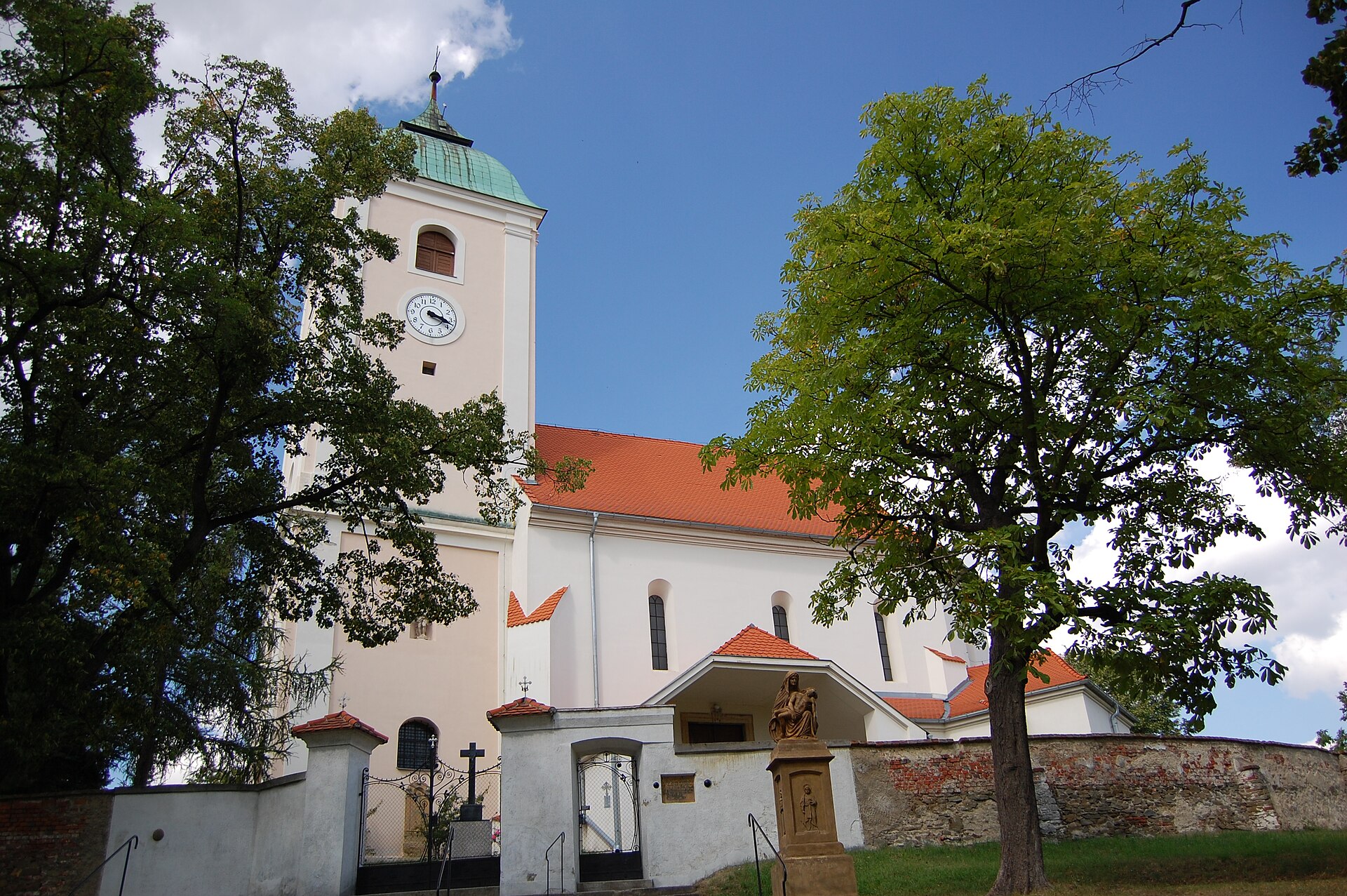
The Church of Saint Martin in Ptení is a modest parish church standing at the heart of Ptení, a village in the Prostějov district of the Olomouc Region. Its story stretches back to a possible 12th-century origin, though the building has been reshaped so many times over the centuries that little of its earliest form survives above ground.
How old is the church really?
The earliest surviving written record dates only to the 15th century, when Hynek of Zvole, the lord of the Ptení estate, granted the church a fixed annual income of five hřivny of grošs. This document doesn't confirm a founding date — it simply proves the church already existed by then. The commonly cited 12th-century origin remains a scholarly assumption rather than a documented fact.
What happened to the parish over the centuries?
Around the turn of the 16th and 17th centuries, under the influence of the Šárovský family, the parish switched away from Catholicism. It was later brought back into the Catholic fold during the Counter-Reformation, a process carried out locally by the priest Jakub Capricius. After this period, the church increasingly became a burial site for the local nobility.
Who is buried inside the church?
In 1695, a family tomb for the Miniati family, the estate's owners at the time, was built directly in front of the main altar. Count Karel Hubert of Oudaille was interred there in 1750. The Miniati crypt remains one of the most notable features of the church's interior today.
How was the 18th-century expansion financed?
In the early 18th century, the church was enlarged at a cost of 300 gold ducats. According to local tradition, the sum was covered by Anna Miniatiová using winnings from a card game — a colorful detail that has stuck to the building's history ever since.
What changed during the 19th century?
The 19th century brought the most dramatic architectural changes. A major reconstruction took place in 1850, followed in 1855 by the installation of a clock on the tower. The most significant intervention came in 1863: the original wooden ceiling was removed and replaced with vaulting, and the building's walls were raised by three meters to accommodate it. The surrounding cemetery was relocated in 1836, leaving behind just two gravestones, dated 1824 and 1830, as the only visible trace of the old burial ground.
What was discovered during 20th-century repairs?
During repair work in 1947, workers uncovered a hidden Gothic portal, physical proof that genuinely medieval elements survive beneath the later rebuilding. The church underwent its most recent comprehensive restoration in 1998 and has been well maintained ever since.
Can visitors enter the church?
Yes, the church is freely accessible and kept in good condition. It makes for an easy stop for anyone exploring the wider Haná region, offering a compact but layered slice of local history away from the more heavily visited landmarks.
Frequently asked questions
How old is the Church of Saint Martin in Ptení? Its origins are commonly placed in the 12th century, but the first documented written evidence dates only from the 15th century.
What can be seen inside the church? The interior holds the Miniati family tomb, established in 1695 in front of the altar, where Count Karel Hubert of Oudaille was also buried in 1750.
Are there any medieval remains still visible? Yes — a hidden Gothic portal was discovered during repairs in 1947, confirming the building's older architectural core beneath its 19th-century remodeling.
Is the church open to visitors? Yes, it is freely accessible and has remained in good condition since its last major restoration in 1998.
Nearby places

Earn badges for the places you visit
Download NextOnTrip, discover new places and check off your trails.