About this place
Chapel of Ecce Homo sits in the spa woods southwest of central Karlovy Vary, in a saddle just below Výšina přátelství (Friendship Height), at roughly 477 metres above sea level. It's a small waypoint on the spa town's forest trails rather than a destination church — more relevant to hikers than to sightseers hoping to step inside.
Where exactly is the chapel located?
The chapel stands at a crossing of forest paths, on a spot that has held a chapel for a very long time — before the current structure, an older Baroque chapel occupied the same site. Because it sits deep in the woods away from the town centre, the setting is quiet and secluded, with views over the surrounding hills rather than street-level bustle.
It's worth not confusing this chapel with a different building of the same name: another Ecce Homo chapel (sometimes also called the Chapel of St. Lawrence) dates from 1897 and stands on I. P. Pavlova street in the northern part of the city. That's a separate, unrelated structure.
What's the history behind the current building?
The chapel visitors see today in the woods dates from 1900, when it replaced the earlier Baroque chapel on the same site. Its architect is unrecorded. When built, it was richly decorated, but much of that decoration was lost after the Second World War. Toward the end of the 20th century the building underwent a thorough reconstruction that gave it its present appearance. Since 19 January 2022, the chapel has been listed as a Czech cultural monument (kulturní památka).
What does the chapel look like, and can you go inside?
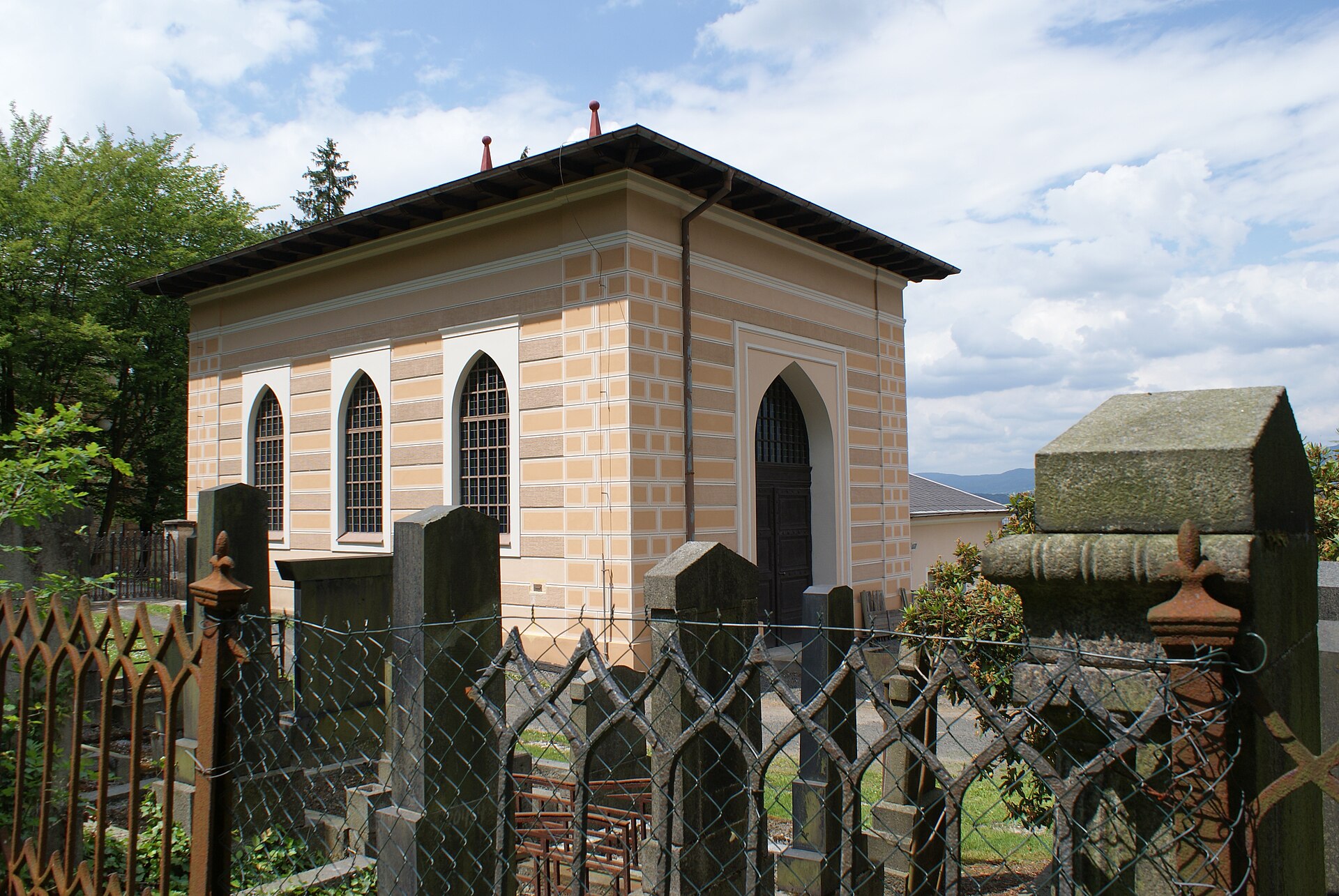
The building is Pseudo-Gothic (Neo-Gothic) in style, built of exposed, unplastered brick. Its plan is rectangular, closing at one end in a three-sided presbytery — an angled, polygonal termination typical of church architecture rather than a flat back wall. According to the town's own information, the interior is not open to visitors; the chapel is meant to be viewed from outside, which fits its role as a trail landmark rather than an active place of worship.
How do you get there on foot?
Two hiking routes lead to the chapel. The longer one, about 1.8 kilometres and marked with yellow trail signs, runs from Poštovní dvůr via the Charles IV lookout point (Vyhlídka Karla IV). The shorter, easier option is a roughly 440-metre walk from the Jelení skok stop at the top of the Diana funicular — by far the quickest way to reach the site without a longer hike.
What else is worth seeing nearby?
Right next to the chapel stand Chopinova chata, a wooden shelter for hikers, and Aranova lavice, a stone bench from 1906 commemorating the Hungarian poet János Arany. Together with the chapel, these form a small cluster of resting points along the trail network through Karlovy Vary's spa forest.
Frequently asked questions
Can you go inside the Ecce Homo Chapel? No — according to the town of Karlovy Vary, the interior is closed to visitors; the chapel can only be viewed from the outside.
What's the fastest way to reach the chapel? The shortest approach is about a 440-metre walk from the Jelení skok stop at the top of the Diana funicular.
Is this the same chapel as the one on I. P. Pavlova street? No. Karlovy Vary has two separate chapels named Ecce Homo — the one described here stands in the spa woods southwest of the centre, while the other, from 1897 and also known as the Chapel of St. Lawrence, is in the northern part of the city.
Is the chapel a protected monument? Yes, it has been listed as a Czech cultural monument (kulturní památka) since 19 January 2022.
Nearby places

Earn badges for the places you visit
Download NextOnTrip, discover new places and check off your trails.