About this place
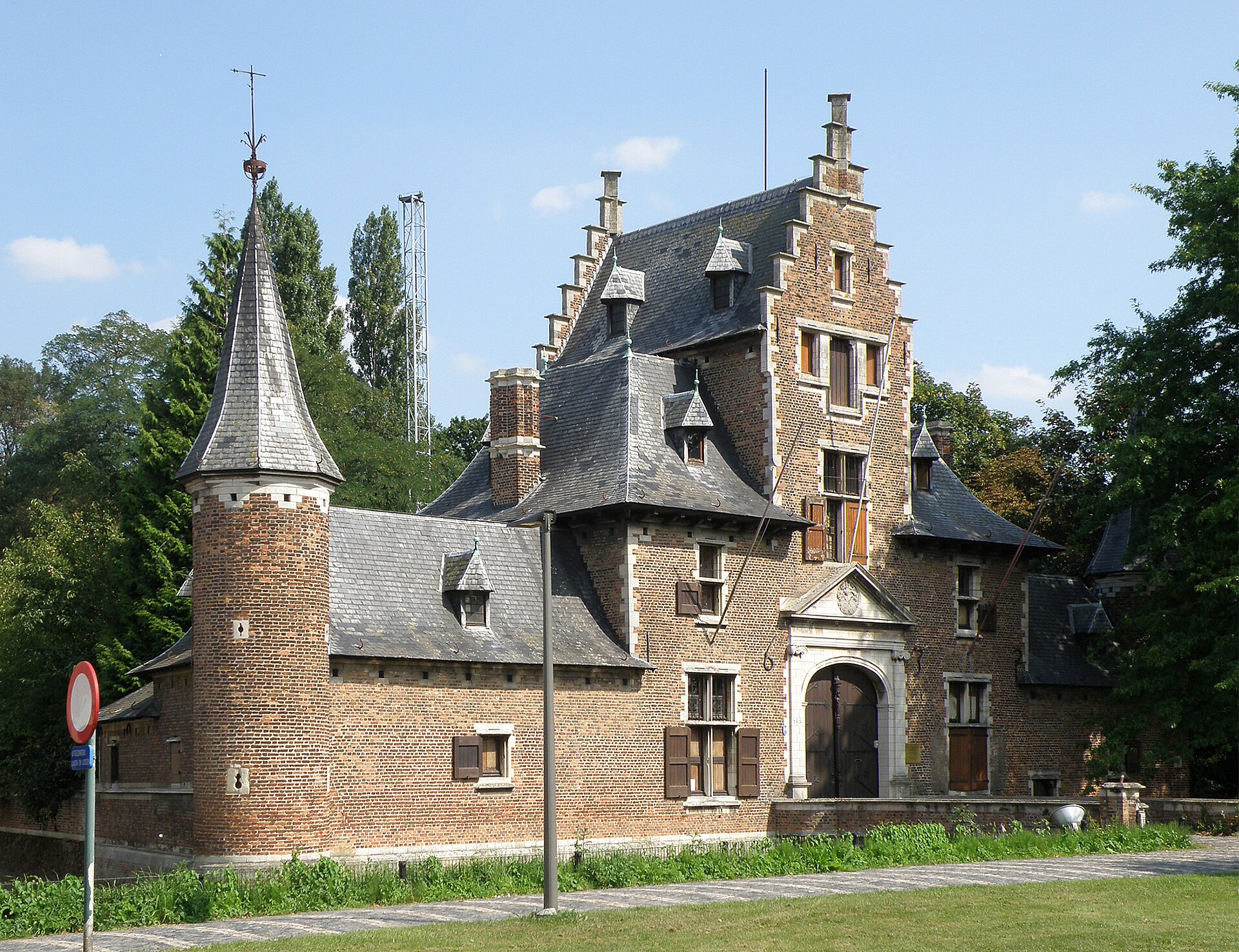
Castle of 's Gravenwezel stands as one of the best-preserved fortified residences in the Kempen region of Flanders, located in the village of 's-Gravenwezel, part of the municipality of Schilde near Antwerp. Encircled by a double moat, the building blends a medieval defensive core with later baroque and neoclassical additions, making it a textbook example of the centuries-long remodeling typical of Flemish noble estates.
When was the castle first built?
The earliest references to a stronghold on this site go back to the 13th century, when the property was already mentioned in the cartulary of the abbey of Villers, and the counts of Wesel held sway over the land. The original structure functioned as a fortified farmstead surrounded by ramparts and a moat, guarding the eastern approach to Antwerp. In the 14th century two massive round corner towers were added; one of them survives today and remains the oldest visible part of the current building.
Who owned the castle through the centuries?
The ownership history is long and eventful. Toward the end of the 13th century the knight Gerard van Wezemaal held the land, and among the later lords was Count Walter of Lippelo, appointed by Duke John II in the early 14th century. In 1495 the estate was purchased by Jan de Glymes, Lord of Bergen op Zoom, and it remained tied to that lordship for most of the 16th century. From the second half of that century onward, wealthy Antwerp merchants took over as owners, reflecting the city's growing importance as a commercial hub.
How did the building's appearance evolve?
The east, west and north facades retain their Gothic character from the 15th century, a clear sign of the castle's medieval roots. A very different chapter opened in the 17th century, when a baroque gatehouse with a dovecote was added — a feature typical of noble residences of the period, signaling the owners' status and wealth. The castle gained its truly stately appearance in 1728, though, when Melchior van Susteren became the new lord. He commissioned architect Jan Pieter van Baurscheit to carry out a thorough renovation, focused above all on the south facade, giving it an elegant neoclassical look that contrasts with the Gothic rest of the building.
Who inherited the castle after the Van Susteren family?
Starting in 1680, the estate passed by inheritance first to the counts Roose de Baisy and later to the barons Gillès de Pélichy, who held it for much of the 19th and 20th centuries. This long line of succession meant the castle was never left to decay, instead being consistently maintained and updated by successive landowning families.
What happens at the castle today?
Since 1984 the residence has belonged to Antwerp antiques dealer and art collector Axel Vervoordt, world-renowned for a refined style that blends minimalism with historic craftsmanship. The castle now serves as his private home and is not open to the public on a regular basis, though its silhouette, glimpsed across the moat and the mature trees of its park, still catches the eye of travelers passing through the Kempen countryside.
Frequently asked questions
Can visitors tour the Castle of 's Gravenwezel? No — since 1984 it has been a private residence and is not generally open to tourists.
Which parts of the castle are the oldest? The surviving round corner tower dates from the 14th century, while the Gothic facades are dated to the 15th century.
Who currently owns the castle? Since 1984 it has belonged to Axel Vervoordt, an Antwerp antiques dealer and art collector.
Where exactly is the castle located? In the village of 's-Gravenwezel, part of the municipality of Schilde, northeast of Antwerp.
Nearby places

Earn badges for the places you visit
Download NextOnTrip, discover new places and check off your trails.