About this place
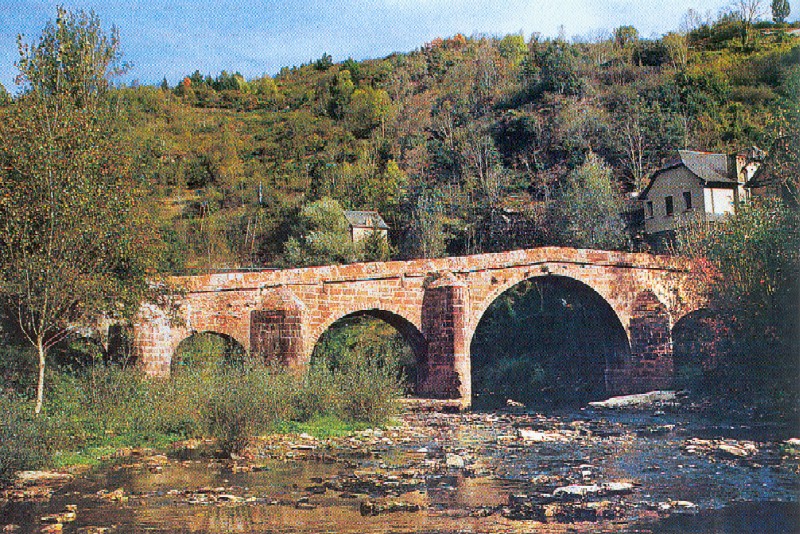
The bridge over the Dourdou is a small stone arch bridge in Conques-en-Rouergue, in the Aveyron department, spanning the Dourdou river right at the entrance to one of France's most celebrated pilgrimage villages. Although it has long been nicknamed the "Roman bridge," the structure actually dates from the Middle Ages, most likely built during the period when the Sainte-Foy abbey was at the height of its influence and Conques had become a key stop on the Via Podiensis, the French stretch of the Way of St. James leading to Santiago de Compostela.
Why is it called the "Roman bridge" if it isn't Roman?
The name comes from a linguistic slip rather than historical fact. In the Occitan language, pilgrims heading to Compostela were called "romieu." Over time this word was folded into the everyday French name "pont romain" — literally "Roman bridge" — even though the structure has nothing to do with ancient Rome. It is a pilgrims' bridge, not a legionaries' one.
What role did the bridge play on the Way of St. James?
For walkers approaching Compostela, the bridge over the Dourdou was the last obstacle before entering Conques itself. After crossing the river, pilgrims made their way to the Porte du Barry, the northern gateway into the village, then climbed the steep lane up to the Sainte-Foy abbey. Built from local stone, the small arched bridge has withstood centuries of foot traffic and still carries walkers along the very route once trodden by thousands of pilgrims.
Why is the bridge part of the UNESCO heritage listing?
The bridge is not a standalone monument separate from Conques — it forms part of the broader UNESCO inscription covering the French sections of the Routes of Santiago de Compostela. Together with the Sainte-Foy abbey, famous for its Romanesque tympanum depicting the Last Judgment and for the reliquary of Sainte Foy, the bridge shows how closely everyday infrastructure was woven into the religious life of medieval Europe. It has also been listed as a French historic monument (monument historique) since 1930.
What else is worth seeing near the bridge?
The bridge makes a natural starting point for exploring the Dourdou valley and Conques itself, a village ranked among the Most Beautiful Villages of France (Les Plus Beaux Villages de France). From the bridge, visitors get a view of the steep, wooded slopes surrounding the village and the silhouette of the abbey rising above the slate rooftops. It is also a pleasant spot to pause before continuing on foot — riverside benches and shade make it an easy place to rest.
Frequently Asked Questions
Is the bridge over the Dourdou actually Roman? No. Despite the popular name "pont romain," the bridge dates from the Middle Ages. The name comes from the Occitan word "romieu," meaning a pilgrim traveling to Compostela.
Is the bridge still used by pilgrims today? Yes. It remains part of the Via Podiensis route and is still crossed by people walking the Way of St. James toward Compostela, just as it was centuries ago.
Can you walk to the bridge from the center of Conques? Yes, the bridge sits right next to the village, near the former Porte du Barry gateway, and is an easy walk from the center of Conques.
Is the bridge protected under UNESCO World Heritage status? Yes, along with the Sainte-Foy abbey, it forms part of the UNESCO listing for the French Routes of Santiago de Compostela.
Nearby places

Earn badges for the places you visit
Download NextOnTrip, discover new places and check off your trails.